Street Art can Change the World
Keith Haring (1958–1990) was a cultural force. With a distinct pop-graffiti style that echoed the vibrant subcultures of New York City in the early 1980s, he developed a bold, graphic style to speak on socially conscious themes, which made him one of the most recognisable figures in modern and contemporary art. But more than anything, Haring worked with the belief that art should be direct, accessible, and rooted in the human experience, a philosophy that continues to define Keith Haring in Barcelona.
While Haring is most closely associated with the New York street art scene, his artistic influence extended globally, including a significant mark on Barcelona’s cultural landscape. For those exploring Keith Haring in Barcelona, Keith Haring’s mural de la SIDA in Barcelona remains a striking example of his artistic and activist legacy. The mural reflects not only Haring’s distinct visual language but also his commitment to social justice and public intervention.
At Moco Museum Barcelona, Keith Haring’s exhibition in Barcelona – Modern Masters offers a rare opportunity to explore his groundbreaking work.
Barcelona’s Hidden Mural
In 1989, just a year before his death, Keith Haring visited Barcelona and left behind one of his most politically charged murals. The mural, titled Todos Juntos Podemos Parar el Sida (Together We Can Stop AIDS), was painted on a wall in the El Raval neighborhood. The mural features Haring’s signature figures linked together in a chain, symbolising unity and collective action.
This work was not decorative. It was a site-specific political intervention responding directly to the AIDS crisis in Spain. In Keith Haring in Barcelona, the mural functions as both a public health message and urgent visual protest.
Interestingly, Haring painted the mural spontaneously, using red paint to reflect urgency and passion. Over the years, the mural faded, but in 2014, it was restored and repositioned on a wall near the original site, becoming a permanent part of Barcelona’s street art history. For visitors seeking the Keith Haring Barcelona location, the mural confronts passersby with emotional subject matter, a kind reminder to unite against injustice and stand together in the face of crisis.
Graffiti Roots and Subway Drawings
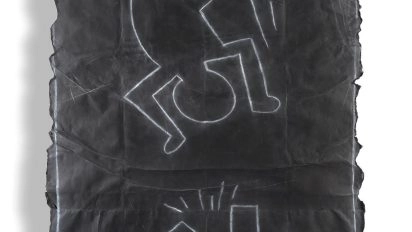
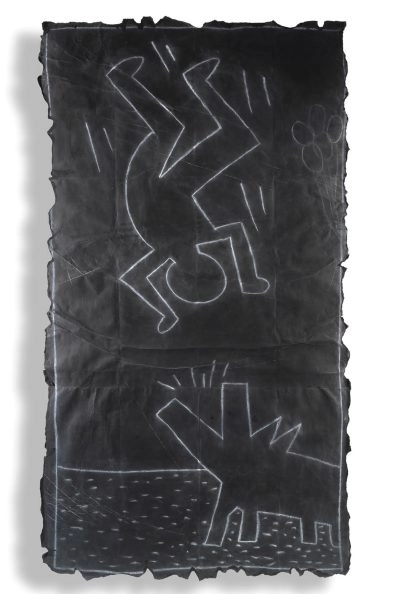
Keith Haring’s artistic journey began not in galleries, but in the subways of New York City. From 1980 to 1985, Haring created over 5,000 chalk drawings on the blacked-out advertising panels in subway stations. These subway drawings were temporary chalk works created on unused advertising panels, functioning as a public laboratory where Haring tested his symbols in real time.
Although sometimes described as Keith Haring doodles because of their speed and clarity, these drawings were intentional communication systems rather than casual sketches. Haring’s subway drawings became a repeatable visual vocabulary built on immediacy, repetition, and public exposure.
At the time, these subway drawings became Haring’s signature medium, blending performance art with social engagement; a pure example of how art can be made accessible to everyone, and a foundation for how Keith Haring in Barcelona is understood today.
Visual Language, Symbols and Meaning
Keith Haring in Barcelona cannot be separated from Keith Haring symbols and their meaning. His recurring figures were not random illustrations but part of a structured semiotic system.
Recurring Keith Haring symbols include:
- Radiant Baby: a crawling infant surrounded by energy lines, representing innocence, potential, and life force.
- Barking Dog: a stylised dog with vibrating lines, often associated with authority, warning, or social tension.
- Dancing Figures: simplified human forms in motion, symbolising collective energy and shared humanity.
- Linked Human Chains: figures holding hands, representing solidarity, unity, and resistance.
Repetition in Keith Haring drawings was not decoration. It was meaning. By repeating these forms across murals, prints, subway drawings, and paintings, Haring built a universal language that transcended borders, including in Keith Haring in Barcelona.
Raising Awareness Through Art
Although Keith Haring was diagnosed with HIV in 1988, he had always dedicated his artistic craft as a platform for activism. Haring’s advocacy extended beyond AIDS, addressing issues of racial inequality, drug addiction, and political corruption. In pieces like Crack is Wack (1986) and Free South Africa (1985), Haring used art to critique systemic injustice and inspire resistance.
In 1989, he established the Keith Haring Foundation to support AIDS research and children’s programs, anchoring his activism institutionally. This commitment to art as communication rather than provocation remains central to understanding Keith Haring in Barcelona and his mural’s political urgency.
At Moco Museum Barcelona, visitors experience his paintings and prints that reflect the joy Haring imbued in his works.
Pop Graffiti Art
While Haring’s work was rooted in street art, his influence extended into the world of commercial design and pop culture. In the mid-1980s, Haring opened the Pop Shop in New York City, a retail space where visitors could buy T-shirts, posters, and other merchandise featuring his art. Keith Haring truly believed that art should be experienced in everyday life, not just in galleries and museums, a belief visible in Keith Haring in Barcelona through public placement and accessibility.
Haring exhibited alongside artists such as Andy Warhol, situating his work between street art and fine art legitimacy while maintaining accessibility.
At Moco Museum Barcelona, visitors can see how Haring’s work continues to intersect with design and fashion with merchandise like T-shirts, magnets, key chains and other collectible pieces, including Keith Haring’s Bearbrick in Barcelona that reflect the ongoing influence of his style in contemporary art and streetwear.
Legacy in Barcelona and Beyond
Keith Haring’s death in 1990 at the age of 31 was a devastating loss to the art world. Yet his work continues to resonate with new generations of artists and activists. His visual language of dancing figures, radiant babies, and barking dogs remains instantly recognisable, a testament to Haring’s ability to create a universally understood art form.
For those searching for Keith Haring art in Barcelona or exploring the city’s vibrant street art scene, Moco Museum Barcelona offers a vibrant introduction to the artist’s work and way of working, reminding us that creativity and activism are inseparable forces and reinforcing the cultural relevance of Keith Haring in Barcelona today.
Exhibiting artists include



Reviews
Practical Information
-
Opening Hours
Monday – Thursday: 10:00 – 19:00
Friday – Saturday: 10:00 – 20:00
Sunday: 10:00 – 19:00
-
Duration
Approximately 60 minutes.
-
Location
Carrer de Montcada 25, El Born. Get directions here.
-
Contact
Email us at [email protected] or visit our contact page.
-
Audio Guide
Free audio tour, bring your headphones.
-
About
Moco Museum Barcelona is an independent modern and contemporary art museum in El Born, showcasing modern, contemporary, digital and immersive art by global icons such as Banksy, Warhol, Basquiat, Haring and Kusama.
Media Reviews
-
 Secret BarcelonaMoco Museum has earned a place among the favorites of art lovers worldwide by connecting with young audiences in a more personal and accessible way. A visit to Moco Museum is an experience that leaves no one indifferent.
 -
 The GuardianAround 65% of visitors to Moco Museum are first-time museum-goers, highlighting its success in opening up the art world to new audiences.
 -
 ABCLocated next to the Picasso Museum, Moco Museum demonstrates how contemporary art spaces can attract younger generations and bring fresh energy to historic cultural districts. Moco Museum shows how private museums can be sustainable while revitalizing and rejuvenating the art sector.
 -
 Condé Nast TravelerBarcelona's Moco Museum is a riot–of colors, of styles, of pushing artistic boundaries. Mainly, of joy.
 -
ABCThere’s a museum in Barcelona full of young people. Impossible? Well, it really exists. It’s called Moco Museum. Moco Museum succeeds in making art appealing to younger generations without sacrificing cultural relevance.
-
 The New Barcelona PostAn internationally successful museum arrives in Barcelona: the Moco Museum.
 -
 TripAdvisorThe museum is well structured and organized, the works are interesting and, certainly, offers a different note than the usual Gaudi and Picasso etc.
 -
 PR NewswireMoco echoes its commitment to exhibiting iconic works by internationally renowned artists and rising stars. For many visitors, Moco is an entry point into the world of art.
 -
The GuardianTargeting 18- to 35-year-olds, Moco Museum is redefining how new audiences engage with modern, contemporary, and street art.
-
Secret BarcelonaWith over 100 modern and immersive digital artworks, every visit becomes a true discovery—because art here isn’t just seen, it’s felt.
“Art is nothing if you don’t reach every segment of the people.”