1. Keith Haring Found His Visual Language in New York
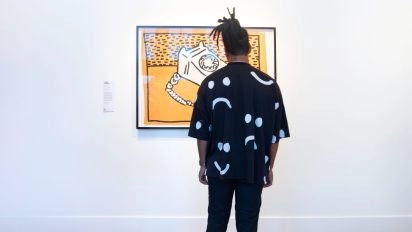
Keith Haring was born in Kutztown, Pennsylvania, in 1958. His early visual world was shaped partly by his father’s cartoon drawings and American popular culture, including Walt Disney and Charles M. Schulz.
In 1978, Haring moved to New York City to study at the School of Visual Arts. There, he became immersed in a creative scene where art, music, nightlife, performance, and queer culture constantly crossed paths.
He also explored semiotics, the study of signs and how they communicate meaning. That interest would become central to his art. Haring did not simply draw figures. He developed signs that could speak without words.
2. The New York Subway Became His “Laboratory”
For Haring, some of his most important artistic experiments happened outside the traditional gallery.
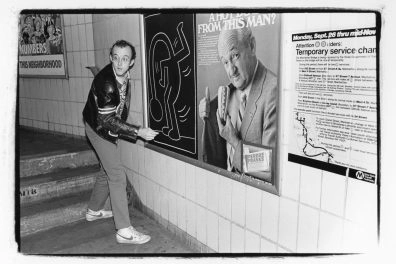
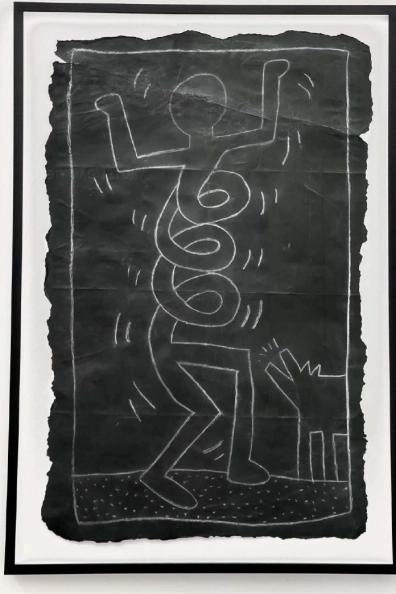
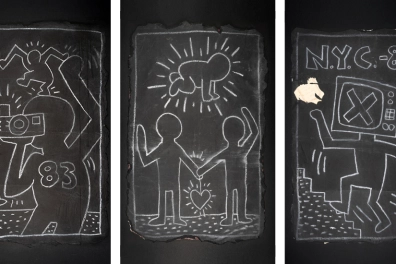
Between 1980 and 1985, he created thousands of drawings in New York subway stations, using white chalk on the black paper panels covering unused advertising spaces. The contrast was immediate: white line, black ground, moving crowd.
Haring described the subway as his “laboratory”, a place where he could test ideas and communicate with people from different backgrounds. Commuters did not need to enter a museum or know anything about art history. The work met them on their way through the city.
This transformed the Keith Haring subway drawings into something more than images. They were encounters.
3. The Subway Drawings Were Made to Disappear
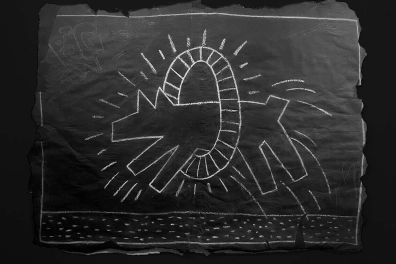
Part of the power of Keith Haring’s subway art came from its temporary nature. Most of these chalk drawings were erased within hours as advertising panels changed, reinforcing the fleeting character of the Subway Drawings.
Haring nevertheless treated these works as complete drawings rather than casual sketches. Speed was part of the method, not evidence of a lack of intention. Working amid commuters and passing trains, while facing repeated fines and arrest, required confidence, repetition, and instinct.
The contradiction remains compelling. Haring created images that would become globally recognisable in places where they could vanish almost as soon as they appeared.
4. His Symbols Created a Universal Visual Vocabulary
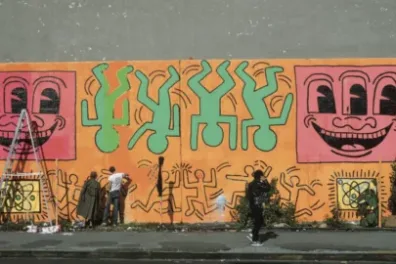
Keith Haring symbols are instantly recognisable because they reduce forms without reducing their emotional force.
The radiant baby, barking dog, dancing figures, angels, and simplified human bodies recur throughout his work. Their meaning can shift depending on context, but together they create a vocabulary built around movement, energy, warning, joy, authority, and connection.
The radiant baby, for example, is often associated with innocence, energy, and potential. The barking dog can suggest authority, warning, or aggressive power structures. Dancing figures evoke movement, collective joy, and shared humanity.
Haring understood the power of repetition. The more these figures appeared, the more familiar they became. Art could communicate before language had time to intervene.
5. His Drawings Were Simple, but Never Empty
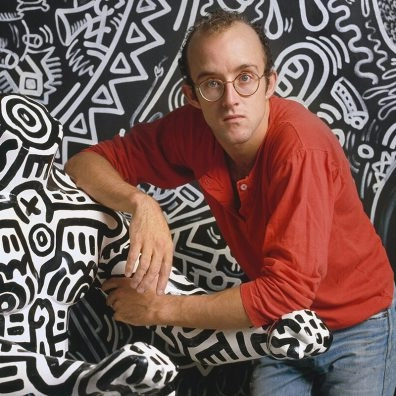
A Keith Haring drawing can look effortless. That immediacy is part of its strength.
His continuous lines, simplified bodies, and repeated marks allowed him to create images quickly, but they were grounded in a deliberate system of communication. This distinction matters when Keith Haring’s work is described as “doodles”. A doodle suggests something incidental. Haring’s drawings were intentional, composed, and repeatedly refined through practice.
His line could suggest a body, movement, emotion, and social tension with remarkable economy. Nothing needed to sit still.
6. Keith Haring Believed Art Belonged in Public Life
The subway drawings reveal one of the clearest ideas running through Haring’s practice: art could exist beyond institutional permission.
Instead of waiting for audiences to enter galleries, he placed his work inside the rhythms of ordinary life. People encountered it between trains, during commutes, and while moving through the city.
That choice changed the relationship between artist and audience. People could stop, watch him work, react, or simply continue walking. Art became part of the city rather than something separated from it.
This commitment to accessibility later extended into Haring’s murals and other public projects. The audience was never an afterthought. It was part of the work.

7. Activism Was Central to His Art
Behind the energetic figures and graphic clarity was an artist deeply engaged with the pressures of his time.
Haring used art to address subjects including sexuality, social inequality, public health, and the AIDS crisis. After being diagnosed with AIDS in 1988, he used his visibility to raise awareness and challenge the stigma surrounding the disease.
In 1989, he established the Keith Haring Foundation, which continues to support AIDS-related organisations and children’s programmes.
His work shows how accessibility and activism could reinforce one another. If an image could reach people immediately, it could also make difficult subjects visible.
8. Pop Culture Was Part of His Artistic World
Haring grew up surrounded by cartoons and popular imagery, and those influences remained visible throughout his career.
In Mickey Mouse USA (1985), he brought the language of popular culture into conversation with his own graphic style. The work also includes “Andy Mouse”, connecting Mickey Mouse imagery with Andy Warhol, an artist who became an important figure in Haring’s life.
For Haring, the borders between street culture, popular imagery, commercial culture, and fine art were porous. An image could move between them and gain new meaning each time.
That crossover remains one reason his visual language continues to resonate across art, design, fashion, and contemporary culture.
9. There Was a Darker Side to Keith Haring’s Work
The dancing figures can be joyful, but Haring’s world was never only optimistic.
Works such as Untitled (Burning Skull) (1987), displayed at Moco Museum London, reveal imagery shaped by mortality and unease. Painted on enamel and aluminum, the work features a burning skull surrounded by figures with X-shaped eyes and sharp teeth, imagery that has been interpreted in relation to religious symbolism and the existential threat of AIDS.
His religious upbringing also informed aspects of his imagery. Raised in a Christian household, Haring briefly became involved with the Jesus Movement as a teenager. Themes connected to salvation and moral reckoning later surfaced within his work.
Joy and anxiety coexist. That tension makes Haring’s art more complex than its familiar symbols might initially suggest.
10. Keith Haring’s Art Still Belongs to the Street and the Museum
Haring died in 1990, but the visual language he developed remains embedded in contemporary culture.
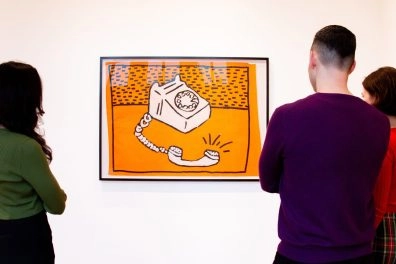
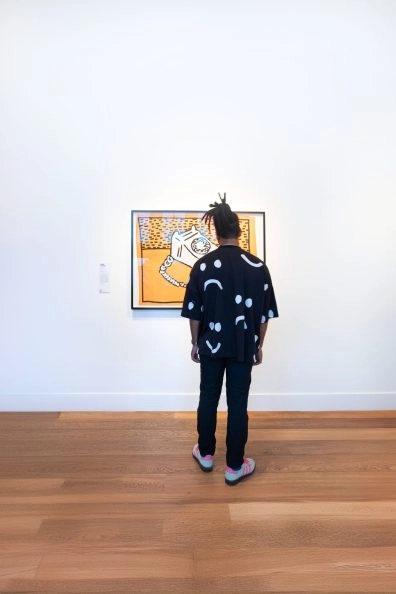
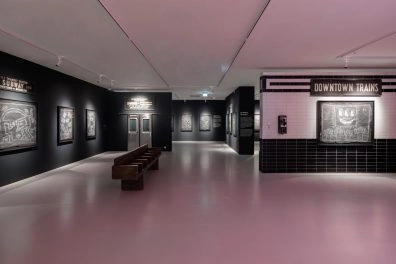
At Moco Museum London, selected works by Haring can be encountered within a wider story of modern and contemporary art. The Keith Haring presentation introduces visitors to his artistic practice and enduring influence on public art and visual culture.
His work can also be experienced within the context of Modern Masters, connecting Haring with artists whose work reshaped twentieth-century visual culture.
Moco Museum is an independent modern and contemporary art museum with locations in Amsterdam, Barcelona, and London, presenting modern, contemporary, digital, immersive, and street art through accessible and emotionally engaging experiences.
Seen from London today, Haring’s journey from subway advertising panels to museum spaces creates a compelling reversal. The work entered public life without waiting for permission. Decades later, museums preserve and reconsider the very images that once challenged where art was supposed to belong.
The setting has changed. The question has not: who gets to experience art, and where?
Keith Haring and the Subway Drawings
The Keith Haring subway drawings remain essential to understanding the artist because they brought together so many parts of his practice at once: speed, repetition, public engagement, accessibility, risk, and a visual language designed to cross barriers.
Haring did not treat the subway simply as a surface. It was an audience, an experiment, and a living part of the work.
That is why the drawings continue to matter. Their original setting may have been temporary, but the idea behind them was larger: art could interrupt an ordinary day and create a moment of connection between strangers.
Frequently Asked Questions
Who was Keith Haring?
Keith Haring was an American modern artist who lived from 1958 to 1990. He became known for bold graphic lines, recurring symbols, public artworks, subway drawings, and socially engaged art.
What was Keith Haring famous for?
Keith Haring was famous for his distinctive visual language of radiant babies, barking dogs, dancing figures, and other recurring symbols, as well as the chalk drawings he created in New York City subway stations.
What are Keith Haring’s Subway Drawings?
Keith Haring’s Subway Drawings are chalk works created on black paper advertising panels in New York City subway stations between 1980 and 1985. Haring used the subway as a public space for artistic experimentation and direct communication.
What do Keith Haring’s symbols mean?
Keith Haring’s symbols form a flexible visual vocabulary. The radiant baby is often connected with innocence, energy, and potential, while barking dogs can suggest authority, warning, or aggressive power structures. Dancing figures frequently communicate movement, joy, and human connection.
Was Keith Haring an activist?
Yes. Haring addressed subjects including sexuality, social inequality, AIDS awareness, and public health through his art. In 1989, he founded the Keith Haring Foundation, which continues to support AIDS-related organisations and children’s programmes.
Where can I see Keith Haring in London?
Selected works by Keith Haring can be seen at Moco Museum London, where his art is presented within the wider context of modern and contemporary art.
How can I buy tickets to see Keith Haring at Moco Museum London?
Tickets to Moco Museum London are available through the official visitor and ticket page. Book tickets online to plan your visit.
Visitor Information
Moco Museum London is located at 1–4 Marble Arch, London, UK, and is open Monday to Sunday from 10:00 to 19:00.
Opening hours: Monday to Sunday, 10:00–19:00.
Duration: Approximately 90–120 minutes
Location: 1–4 Marble Arch, London, UK
Audio tour: Free audio tour available. Bring your headphones.
Reason to visit
Keith Haring made art for people in motion. His subway drawings interrupted commutes, challenged the boundaries of the art world, and transformed a passing moment into a shared visual experience.
At Moco Museum London, his work can be encountered within a wider conversation about modern and contemporary art, public expression, and the artists who changed how culture communicates.
Discover Keith Haring’s visual language in London, from the energy of his lines to the ideas about accessibility, connection, and change that continue to give them meaning.