Where can you see Banksy in London?
There is no single Banksy location in London. His work can be encountered through surviving street pieces, relocated works, and original authenticated artworks displayed in museums and collections.
Some outdoor Banksy works remain visible, but street art is inherently unstable. A piece that exists today may later be painted over, damaged, removed for preservation, or relocated.
Inside museums, the experience changes. At Moco Museum London, Banksy’s work moves from the uncertainty associated with the street into a curated contemporary art context. Moco is an independent modern and contemporary art museum with locations in London, Amsterdam, and Barcelona, presenting modern, contemporary, street, digital, and immersive art through accessible and emotionally engaging experiences.
For anyone planning a Banksy focused visit, the most useful distinction is simple: do you want to find art in the streets, or spend time with authenticated Banksy works in a museum?
London lets you explore both sides of that story.
Banksy street art in London: what can you still see?
Searching for Banksy street art in London comes with an important warning. Locations and conditions change.
Street art is exposed to weather, development, cleaning, vandalism, other artists, property decisions, and theft. Banksy’s London works are no exception. Several famous pieces have disappeared completely, while others have been removed or relocated for protection.
Banksy street art locations in London can change quickly. Before travelling to a specific mural, check its current status because works may be damaged, covered, removed, relocated, or preserved elsewhere.
As of the latest 2026 reporting, these are among the Banksy works and locations in London worth knowing.
Banksy’s elephants in Chelsea
Two elephants appeared through blocked windows on a building at Edith Terrace in Chelsea in August 2024 as part of Banksy’s sequence of animal works across London.
The elephants remain at the location. One was defaced with stripes but was subsequently repaired.
The setting matters. There is no gallery frame or controlled viewing distance. Architecture becomes part of the image.
Banksy’s pelicans in Walthamstow
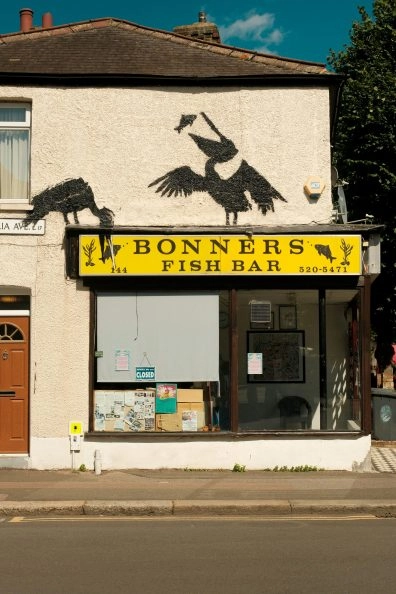
Another work from the 2024 series shows two pelicans on the side of a fish shop on Pretoria Avenue in Walthamstow.
The work remains at the location according to the latest 2026 survey of Banksy works in London.
Here, place becomes part of the joke. The birds and the fish shop share the same visual story.
Banksy’s rhino in Charlton
Banksy’s 2024 animal sequence also brought a rhinoceros to Charlton.
The mural remains, although it has been defaced and the car that originally formed part of the composition is no longer there.
It is a useful example of why Banksy locations cannot be treated like conventional museum objects. A street work can survive while its original surroundings change.
Banksy’s tree mural in Finsbury Park
In March 2024, Banksy transformed a wall behind a severely pruned tree on Hornsey Road in Finsbury Park with an expanse of green paint and a stencilled figure.
The work has since been defaced with white paint. It remains an example of how quickly the physical condition and context of street art can evolve.
Earlier Banksy works around London
Fragments and protected examples of earlier Banksy street art can still be found around London.
One of the oldest surviving examples is the mock royal family in Stoke Newington Church Street. It dates from 2001 and remains protected, although the image has faded considerably. Older Banksy rats and other traces also survive in varying states around the city.
Their condition is part of their history. Street art was never guaranteed permanence.
What happened to Banksy’s 2024 London animal artworks?
Banksy’s nine animal works from August 2024 demonstrate how quickly the status of street art can change.
Some remain in their original locations. Others do not.
The mountain goat in Kew was removed for preservation. The monkeys near Brick Lane were later removed. The wolf painted onto a satellite dish in Peckham was stolen shortly after appearing. The big cat in Cricklewood was removed. The gorilla at London Zoo was taken down for safekeeping. The elephants, pelicans, and rhino remain in their locations according to the latest available survey.
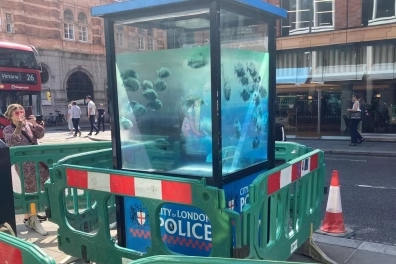
The piranhas painted onto a City of London police sentry box followed another path. The work was removed and donated to London Museum for preservation and future public display.
One series. Nine works. Several very different afterlives.
That is part of the difficulty of answering a seemingly simple question such as, “Where are the Banksy murals in London?”
The answer keeps moving.
Banksy’s newer London works
Banksy has continued to intervene in London since the 2024 animal series.
In September 2025, Banksy confirmed a mural on the Queen’s Building at the Royal Courts of Justice depicting a judge striking a protester with a gavel. The work was quickly covered, and authorities said it would be removed to preserve the historic building.
In December 2025, Banksy confirmed another mural at Queen’s Mews in Bayswater. It depicts two children lying on the ground, with one pointing towards the sky. A visually identical work also appeared near Centre Point, although contemporary reporting distinguished between the confirmed Bayswater work and the second image.
Then, in April 2026, Banksy moved from the wall to the plinth.
A large sculpture appeared at Waterloo Place in St James’s, showing a suited figure stepping forward while a flag obscures the figure’s face. Banksy subsequently confirmed the work through his social media.
The sculpture was still at Waterloo Place in late July 2026 while Westminster City Council considered its future. Because its longer term status had not yet been settled in that reporting, visitors should verify whether it remains in place before travelling specifically to see it.
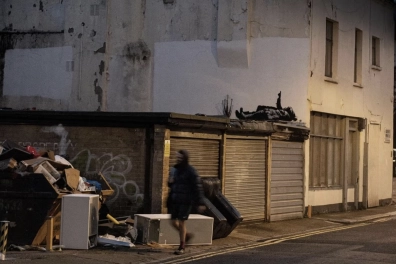
These appearances show why any definitive map of Banksy art locations in London has a short shelf life. New work can arrive without warning. Existing work can disappear almost as quickly.
Banksy beyond the street: museums and collections in London
Once a Banksy work leaves the street, the questions change.
Who owns it? How was it acquired? Has it been authenticated? Is it a painting, print, edition, relocated street piece, or another type of work?
These distinctions matter because Banksy art describes more than murals painted directly onto public walls.
Banksy has worked across paintings, prints, editions, sculpture, installations, and street interventions. Some works enter private collections. Others appear in museum contexts.
London Transport Museum, for example, displays a Banksy rat originally painted on a railway signalling box in Croydon in 2019. The painted door was removed for protection and is now presented within another signal control cabinet at the museum.
A work like this carries part of its original context with it, but the encounter has changed. What was once vulnerable infrastructure has become a preserved museum object.
That transformation leads to one of the most interesting questions surrounding Banksy.
What happens when Banksy enters a museum?
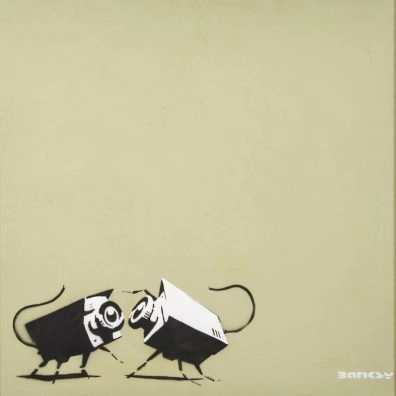
Banksy’s visual language is closely associated with the street: walls, surveillance, authority, public space, unexpected encounters, and the possibility that an image may disappear.
A museum offers almost the opposite conditions. It protects, interprets, and preserves.
The contradiction is difficult to ignore.
Banksy’s work repeatedly engages with authority, consumer culture, war, surveillance, and conventional ideas of artistic value. Yet his works also circulate through museums, collections, galleries, and the art market.
There is no need to resolve that tension.
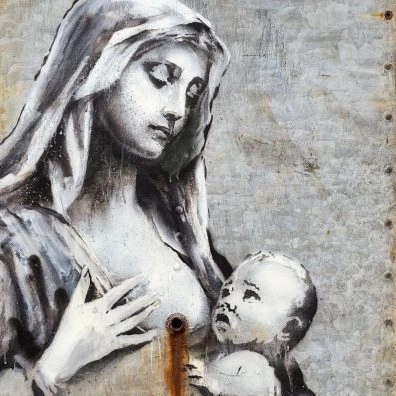
Perhaps something changes when a street artist enters an institution. Something else also becomes possible: slower looking, preservation, context, and public access to works that might otherwise remain in private collections.
Moco’s relationship with Banksy sits inside this tension. Its approved museum content presents Banksy through the movement from streets into museum spaces and asks what happens when imagery associated with rebellion enters an institution shaped by curation and preservation.
Street art enters the museum.
The questions enter with it.
Banksy at Moco Museum London
At Moco Museum London, Banksy appears as a central contemporary voice within Contemporary Masters rather than simply as a chapter in street art history.
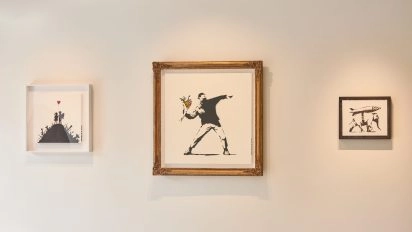
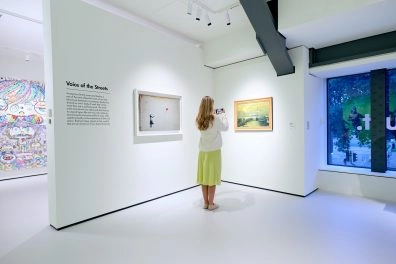
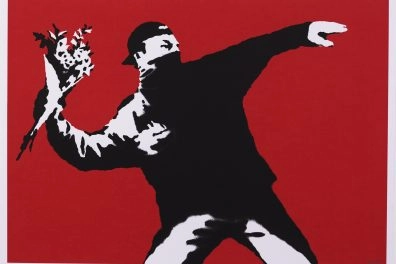
Moco Museum London presents original, authenticated Banksy artworks as part of Contemporary Masters, a permanent yet evolving exhibition. Individual artworks may rotate, so not every work associated with the exhibition is guaranteed to be on view during every visit. The presentation explores recurring ideas in Banksy’s work including authority, surveillance, resistance, humour, and the contradictions of contemporary urban life. Rats, monkeys, police officers, children, and surveillance imagery turn familiar visual language into questions about how people live with power. Approved Moco London content references familiar Banksy images including Girl with Balloon, Flower Thrower, and Smiling Copper. Because the exhibition evolves and artworks may rotate, visitors should not assume that every named work will be displayed on a specific date.
Explore the current Banksy exhibition in London before visiting.
Are the Banksy artworks at Moco authentic?
Authentication deserves particular care when discussing Banksy.
Banksy artworks shown at Moco Museum London are independently verified for provenance and authenticity.
Pest Control is the official body responsible for authenticating Banksy artworks. Moco’s approved Amsterdam and Barcelona content specifically states that works presented at those locations have Pest Control authentication.
The approved London material uses different wording. It states that Banksy works shown at Moco Museum London are independently verified for provenance and authenticity. It does not state in the supplied London source that every London work carries a Pest Control certificate.
The supplied London material also does not support claiming that Banksy collaborated with, curated, or endorsed the Moco Museum London exhibition.
That distinction matters.
Authentication of an artwork and artist authorisation of an exhibition are separate questions.
Banksy paintings, prints and street works: what is the difference?
Someone searching for Banksy paintings in London may actually be looking for several different things.
A Banksy street work is created directly within a public or urban environment. Its location can be fundamental to how the image is experienced.
A painting or other unique work exists as an independent object rather than as part of a building or street surface.
A print or edition is produced in multiples within an edition. An authenticated edition is a genuine Banksy work, but it should not be described as an original street mural.
A relocated street work occupies another category. The Banksy rat at London Transport Museum, for example, originated on railway infrastructure before being preserved and moved into a museum setting.
These distinctions help explain why the question “Where can I see Banksy in London?” has more than one answer.
Banksy and London: a relationship built on contradiction
London is particularly suited to the questions running through Banksy’s work.
Power and protest. Surveillance and anonymity. Wealth and inequality. Institutions and rebellion.
His visual language often works through collisions like these.
Banksy’s relationship with London also reaches back well before the recent murals now protected, removed, or displayed in museums.
In 2005, Banksy staged Crude Oils in Notting Hill. Moco’s approved artist material describes the exhibition as a confrontation with established painting traditions, using altered versions of familiar works alongside live rats.
Years later, Banksy’s work occupies museum spaces.
The tension has not disappeared. It has simply moved indoors.
Frequently Asked Questions
Where can I see Banksy art in London?
Banksy art can be encountered at surviving street locations around London and inside museums. Moco Museum London presents original, authenticated Banksy artworks within its Contemporary Masters exhibition, while other Banksy works remain outdoors or have been relocated into museum collections.
Where are Banksy street art locations in London?
Surviving Banksy street art can be found in several parts of London, including Chelsea, Walthamstow, Charlton, Finsbury Park, and Stoke Newington. Their condition and availability can change, so check the current status before travelling specifically to see a work.
Are there still Banksy murals in London?
Yes. Some Banksy murals remain visible in London, although their condition varies. Other works have been painted over, damaged, stolen, removed for preservation, or transferred to museums and collections.
Can I see Banksy paintings and artworks in a London museum?
Yes. Moco Museum London presents original, authenticated Banksy artworks as part of Contemporary Masters. Because the exhibition evolves, individual works may rotate over time.
Is the Banksy exhibition at Moco Museum London authorised by Banksy?
The supplied approved London material does not state that the exhibition is authorised or curated by Banksy. It confirms that the artworks are independently verified for provenance and authenticity. Artist authorisation of an exhibition and authentication of individual artworks are different claims.
What is Pest Control?
Pest Control is the official body responsible for authenticating Banksy artworks. Moco’s approved Amsterdam and Barcelona materials specifically reference Pest Control certificates for Banksy works at those locations. The supplied London material instead states that its exhibited Banksy works are independently verified for provenance and authenticity.
Is all Banksy style street art in London authentic?
No. A stencil or image that resembles Banksy’s style should not automatically be attributed to the artist. Recent London examples show why confirmation matters: Banksy confirmed the Queen’s Mews mural in December 2025, while contemporary reporting initially distinguished it from an identical image near Centre Point.
Does Banksy still make art in London?
Yes. Banksy has continued to create work in London in recent years, including the 2024 animal series, a Royal Courts of Justice mural in 2025, a confirmed Bayswater mural in December 2025, and a sculpture installed at Waterloo Place in April 2026.
Visiting Moco Museum London for Banksy
Moco Museum London is an independent modern and contemporary art museum presenting modern, contemporary, street, digital, and immersive art, including original, authenticated works by Banksy.
Location: Moco Museum London
Opening hours: Open daily. Hours may vary.
Accessibility: Check current visitor information before arrival.
Good to know: Banksy’s work forms part of Contemporary Masters, a permanent yet evolving exhibition. Individual artworks may rotate.
Learn more about Banksy in London and Moco’s approach to modern art in London.
Reason To Visit
Seeing Banksy in London can mean finding a mural in the city and discovering that time has already changed it. It can also mean standing in front of an authenticated work in a museum and having the space to look more closely.
Neither experience completely explains Banksy.
Together, they reveal the tension that makes his position in contemporary culture so unusual: an anonymous artist associated with public space, protest, satire, and rebellion whose work now also occupies museums and collections.
At Moco Museum London, that contradiction is not something to solve. It is something to look at more closely.