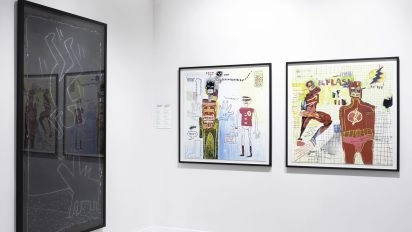
Together, these works show why a modern art museum in Barcelona can speak as much about the present as the past. Modern art does not end neatly at the edge of a historical period. Its experiments with representation, popular culture, public life, and artistic freedom continue through contemporary and digital forms.
This is where Moco’s perspective comes into focus. The museum brings established icons into dialogue with contemporary and emerging voices, connecting the history of modern art with the culture visitors recognise today. Across its locations in Amsterdam, Barcelona, and London, Moco connects established names with emerging voices and new forms of artistic expression.
Banksy: when authority learns to smile
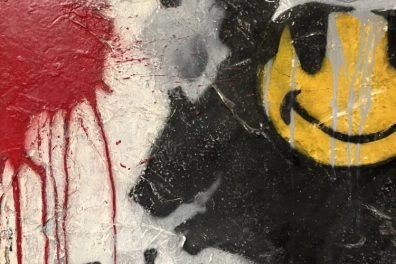
In Smiling Copper (Panel B), a life-size riot police officer stands before you like a barrier. The officer’s intentions are obscured by a smiley face. Protection and intimidation suddenly occupy the same image.
Banksy repeatedly turns recognisable symbols of power into questions. Here, the smile does not necessarily make the officer friendlier. Instead, it creates uncertainty. What happens when an image associated with happiness hides the identity of someone with authority?
The work connects directly with the themes of Disrupted Power, the major Banksy exhibition presented within Contemporary Masters at Moco Museum Barcelona. The exhibition brings together twenty-five works authenticated by Pest Control, the only official body authorised to authenticate Banksy’s art, and examines authority, control, and their breaking points. Banksy uses irony, familiar imagery, and visual disruption to make systems of power visible, part of the reason his work holds an important place within Moco’s presentation of contemporary culture.
Look closely at the contradiction. The smile is simple. Almost universal. The situation is not.
Banksy: who decides what deserves our attention?
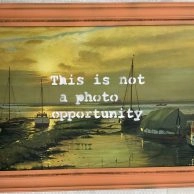
This Is Not a Photo Opportunity, currently on display at Moco Museum Barcelona, turns a phrase into a challenge.
Museums today exist in two spaces at once: the physical gallery and the digital feeds that continue beyond it. Art can become an image captured, posted, shared, and scrolled past within seconds. Seen through the lens of contemporary museum culture, Banksy’s words make that behaviour difficult to ignore.
The work creates a particularly relevant question inside a museum. When does documenting an experience begin to replace experiencing it?
That tension matters at Moco Museum Barcelona, where highly visual contemporary, street, digital, and immersive art often invites visitors to reach instinctively for their phones. The work interrupts that impulse. Instead of telling you what deserves a photograph, it creates a moment to consider why you wanted one in the first place.
Perhaps the most interesting response is not putting the phone away. It is simply noticing the moment you reach for it.
Keith Haring: art made for everyone
Keith Haring understood that art did not need to wait for an audience to enter a gallery. He could meet people where they already were.
His Subway Drawings appeared in unused advertising spaces throughout New York City’s subway system. Created quickly with bold, flowing lines, they brought Haring’s instantly recognisable imagery directly into everyday public life. Because the advertising spaces changed constantly, the drawings could remain visible for only days or weeks.
The Subway Drawing (Dolphin) presented within Moco’s Modern Masters exhibition carries that history into a very different setting. What began as an intentionally public and temporary intervention can now be encountered inside a museum.
The change of context invites another way of looking. Haring wanted to connect with people across cultural, educational, and social boundaries. His simplified figures avoided fixed markers of gender, race, religion, or sexual orientation. The imagery was immediate because accessibility was part of the idea.
Watch the line. Haring could make a body move with remarkably little information. That economy gives his figures their energy, but it also explains why his imagery could travel so easily from the subway to posters, activism, public murals, and eventually museums.
At Moco, Haring helps connect modern art with street culture and the idea that meaningful art can belong to everyone.
CJ Hendry: wonder as a contemporary language
Not every work confronts authority. Some invite us to reconsider how closely we still look at the world around us.
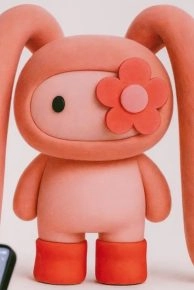
CJ Hendry’s Juju takes over the space through scale, texture, and personality. Created in 2025 from steel, fiberglass, wood, and fabric, the monumental sculpture measures more than 2.7 metres at its highest dimension. A single flower covers one eye. Its soft, rounded body feels strangely familiar, somewhere between sculpture, character, and companion.
CJ Hendry is a self-taught Australian artist based in New York, known for hyper-realistic paintings of luxury objects as well as immersive, participative installations. Juju shifts that fascination with objects towards imagination and emotional attachment.
Its soft silhouette recalls the language of contemporary character design, from figures such as Labubu to animated worlds associated with Disney and Sanrio. Yet its emotional origin is personal. The name Juju comes from an affectionate nickname for Hendry’s mother, Judy. The sculpture balances playfulness with contemplation, turning a monumental character into something that can feel surprisingly companionable.
Juju was acquired by Moco Museum in 2026 and added to the Barcelona display in summer 2026, making it a recent addition for returning visitors.
Its arrival also demonstrates why Moco’s displays should not be understood as static. Returning visitors can encounter new artists, new works, and new relationships between them.
Move beyond the character’s face. Look at its surface, scale, and materials. Part of Juju’s strange charm lies in the moment an object begins to feel as though it has a personality of its own.
Yago Hortal: Barcelona expressed through colour
With Yago Hortal, the perspective becomes unmistakably local.
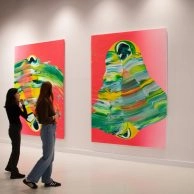
Born and raised in Barcelona, Hortal builds paintings through colour, gesture, and physical movement. SP123, created in 2016, is an acrylic-on-canvas work measuring 260 by 180 centimetres and authenticated by the artist. Giant waves and splashes of thick paint move across its surface, balancing spontaneous action with deliberate control.
Hortal connects this approach to Abstract Expressionism, but his paintings also belong firmly to the contemporary city around them. He works with industrial colours and materials that reference an urban experience, while music helps shape his emotional state before he begins painting.
For Hortal, the gesture itself can preserve a moment. As he explains, the rhythm of a brushstroke can reflect the instant in which it was made, turning his paintings into a kind of personal diary.
That idea gives SP123 another dimension. The paint does not simply suggest movement. It records it. Energy reaches the canvas and remains there as a physical signature.
Its presence at Moco Museum Barcelona matters for another reason. A museum shaped by internationally recognised names also has a relationship with the city around it. Showing an artist born and raised in Barcelona alongside global figures places local contemporary practice within a wider cultural context rather than treating it as a separate story.
Look for movement without a figure moving. Hortal creates momentum through colour itself. In a city already shaped by intense relationships between art, architecture, colour, and public life, his work offers another Barcelona: abstract, physical, and contemporary.
Les Fantômes: when the street becomes digital
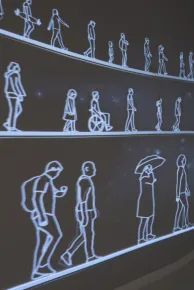
Human movement becomes almost weightless in Parade Infinie (Endless Parade) by Les Fantômes.
The Nantes-based digital artists are known for using minimal silhouettes projected into urban environments. At Moco Museum Barcelona, that approach moves from the city night into the museum as an endless flow of bodies.
Parade Infinie (Endless Parade) by Les Fantômes is currently presented as part of Moco Museum Barcelona’s Digital & Immersive Art experience, where digital forms expand how visitors can encounter movement, space, and contemporary visual culture.
There is little individual detail, yet the figures feel unmistakably human. Movement becomes identity. A stride, a gesture, a rhythm is enough.
That simplicity creates an unexpected connection with Haring. Both reduce the human body to a direct form. One emerged through chalk drawings in New York subway stations. The other uses digital projection. Decades and technologies separate them, but both explore how little an artist needs to make a body feel alive.
This relationship helps reveal Moco’s wider perspective on modern and contemporary art. Artistic expression does not stop developing when a new medium arrives. It adapts.
What these highlights reveal about modern art in Barcelona
Seen together, these six works resist becoming a checklist of famous names.
Banksy turns authority and image culture into questions. Haring shows how art can escape traditional boundaries and speak directly to a public audience. Hendry uses character, scale, and emotion to restore a sense of wonder. Hortal makes colour physical while bringing a Barcelona voice into an international context. Les Fantômes translate human movement into a digital experience.
Different generations. Different mediums. Different concerns.
Yet a shared idea runs through them: art changes as culture changes.
That is central to Moco Museum’s perspective. Modern art opened new possibilities for what an artwork could represent and how an artist could communicate. Contemporary, street, digital, and immersive practices continue to test those possibilities against the world we inhabit now.
The highlight, then, is not simply the object in front of you. It is the conversation it begins.
Frequently Asked Questions
What modern and contemporary art can I see at Moco Museum Barcelona?
As of September 2026, highlights currently on display at Moco Museum Barcelona include works by Banksy, Keith Haring, CJ Hendry, Yago Hortal, and Les Fantômes. Displays can change as exhibitions evolve and artworks rotate.
Is Smiling Copper by Banksy currently on display in Barcelona?
Yes. As of September 2026, Smiling Copper (Panel B) is on display at Moco Museum Barcelona as part of Disrupted Power, the Banksy exhibition within Contemporary Masters. Panel A is not currently on display.
Are all artworks at Moco Museum Barcelona part of the permanent Moco Collection?
No. Moco Museum Barcelona can present works from the Moco Collection alongside loans, private collections, exhibitions, and changing installations. The status of an individual artwork should therefore not be inferred simply from its presence in the museum.
Is Juju by CJ Hendry at Moco Museum Barcelona?
Yes. Juju, created by CJ Hendry in 2025, was acquired by Moco Museum in 2026 and added to the Barcelona display in summer 2026.
Is Moco Museum Barcelona a modern art museum?
Yes. Moco Museum Barcelona is an independent modern and contemporary art museum presenting modern, contemporary, street, digital, and immersive art in Barcelona.
Does Moco Museum Barcelona have digital and immersive art?
Yes. Moco Museum Barcelona presents digital and immersive art alongside modern and contemporary works, including Parade Infinie (Endless Parade) by Les Fantômes.
Visitor Information
Moco Museum Barcelona is located in El Born. All six works discussed in this article are confirmed as on display as of September 2026. Individual artworks and displays may change or rotate over time, so future availability is not guaranteed.
For current opening information, accessibility details, and admission, plan your visit before arrival.
Look closer at modern art in Barcelona
A museum highlight does not have to be the artwork you recognise first. It can be the work that changes once you know where to look.
At Moco Museum Barcelona, familiar names sit beside newer voices, physical artworks beside digital experiences, and global perspectives beside artists connected to Barcelona itself. Together, they reveal modern and contemporary art as an evolving way to explore power, identity, humour, emotion, public space, and human connection.
Come for the names you know. Leave looking differently at the works you did not.