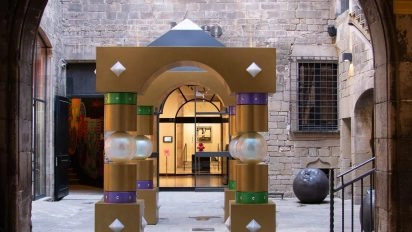
One street can hold centuries.
Walk along Carrer de Montcada and the stone façades, courtyards, arches, and palaces carry you into Barcelona’s past. Step through their doors and another history begins. Picasso’s experiments helped transform the possibilities of modern art. Further along the same street, Moco brings visitors into later modern and contemporary visual culture through Pop Art, street art, social commentary, digital environments, and immersive experiences.
This is not a story about one museum picking up exactly where another finishes. Art history is rarely that neat. The more interesting connection is physical as much as artistic. Visitors leave one historic setting, remain on the same old Barcelona street, and enter another, while the art inside moves across radically different periods and ways of seeing.
For anyone exploring modern art in Barcelona, Carrer de Montcada becomes more than the route between the two museums. The street remains the historic frame while the art inside keeps redefining how we see.
Carrer de Montcada: a historic street shaped by art
Before entering either museum, look at the street itself.
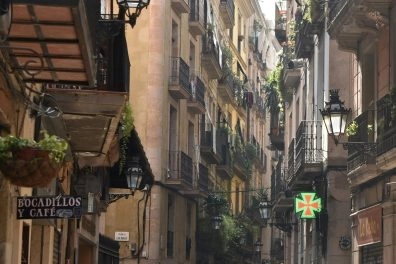
Carrer de Montcada dates back to the 12th century and developed into one of Barcelona’s important aristocratic and mercantile streets. Large landowning and merchant families began building substantial houses there from the 13th century onwards. Today, Museu Picasso describes it as the city’s most important area of medieval civic architecture, with the palaces, stone façades, and courtyards giving the street its distinctive character. Carrer de Montcada was declared an artistic historical heritage site in 1947.
The architecture changes how you encounter the art. Centuries old spaces surround works created by artists who challenged the conventions of their own periods. The street itself becomes part of the experience rather than simply an address shared by two museums.
That relationship has another layer. Museu Picasso opened in Palau Aguilar on Carrer de Montcada in 1963, and its presence became part of a wider effort to restore cultural life to the area. The museum later expanded into neighbouring historic properties.
Today, moving between Museu Picasso and Moco means staying within that same historic environment. You leave one palace, continue along Carrer de Montcada, and enter another. The architecture remains unmistakably Barcelona. What happens inside changes dramatically.
Picasso, Barcelona and the development of modern art
Picasso is fundamental to modern art because he repeatedly reconsidered how painting could represent bodies, space, identity, emotion, and perspective. Most famously, his work with Georges Braque in the development of Cubism challenged the expectation that an artwork should reproduce the world from one stable viewpoint.
Objects and bodies could be fragmented. Several perspectives could coexist. Representation itself became something an artist could question rather than simply perform.
Barcelona is particularly important to understanding how Picasso reached the point where such experimentation became possible. He lived in the city during formative years, developing personally and professionally there between 1895 and 1904. The city was where he continued his artistic training, established early studios, and became involved in its cultural life.
This is where Museu Picasso offers something more revealing than an encounter with an already famous name.
The museum describes itself as a reference point for understanding Picasso’s formative years, with a collection of around 5,000 works. Painting, drawing, ceramics, sculpture, graphic work, illustrated books, and sketchbooks sit alongside subjects ranging from Barcelona landscapes and friends to family and academic studies.
Seeing that development matters because radical artistic change rarely appears from nowhere. Academic training, observation, experimentation, and departure sit beside one another. Picasso’s later challenges to conventional representation become more legible when you can also see the foundations from which he moved.
The building reinforces that sense of accumulated time.
Museu Picasso Barcelona occupies five historic houses or palaces on Carrer de Montcada. The original palaces date mainly from the 13th to 15th centuries and share characteristics of Catalan civic Gothic architecture, including courtyards and exterior stairways leading to the principal floors.
Picasso’s experiments with modernity therefore unfold inside architecture carrying a much older Barcelona. Leaving those spaces does not mean leaving that history behind. Carrer de Montcada carries it with you towards Moco.
Palau Cervelló: history outside, contemporary culture inside
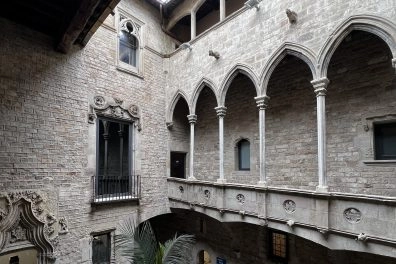
Moco Museum Barcelona is housed in Palau Cervelló on Carrer de Montcada. Formerly the private residence of the Cervelló family until the 18th century, the building incorporates architectural elements dating to the 15th century.
Inside, those layers remain perceptible. An interior courtyard and arched staircase lead through a building with Renaissance style columns and capitals and a Gothic influenced entrance. They are more than a decorative backdrop to Moco’s programme. They create a physical tension between the history of the building and the art encountered within it.
At Moco Museum Barcelona, a centuries old palace becomes the setting for modern, contemporary, street, digital, and immersive art.
A Banksy work about authority does not arrive in a neutral white space. Digital light enters rooms connected to centuries of architectural history. Pop Art and contemporary visual culture appear beyond an entrance shaped by a much older Barcelona.
That contrast is central to the experience of Moco in El Born. The museum does not need to erase the age of Palau Cervelló to feel contemporary. The distance between the building and the work gives each greater presence.
Old stone. New images. Historic rooms. Digital light.
From Picasso to later modern and contemporary visual culture
A short walk separates the museums. Artistically, the distance opens into decades of experimentation.
At Moco, Modern Masters introduces visitors to artists who changed visual culture in very different ways. Andy Warhol turned consumer goods and celebrity into the language of Pop Art. Jean Michel Basquiat brought words, symbols, anatomy, history, and identity into charged compositions. Keith Haring developed a direct graphic language that moved between public space, activism, and the art world. Yayoi Kusama transformed repetition and the dot into ways of thinking about perception, selfhood, and infinity.
Their work is not a straightforward continuation of Picasso, and the museums should not be read as one chronological timeline. Carrer de Montcada offers something less linear and more revealing: different moments when artists reconsidered the visual language available to them.
Picasso fractured conventional perspective. Warhol looked at mass production and fame. Basquiat layered identity, language, and power. Haring took an immediately recognisable graphic language into public space. Kusama made repetition something a viewer could experience as well as see.
The methods change because the worlds around the artists change too.
From modern art to street art: Banksy at Moco
Banksy shifts the relationship between artwork, place, and audience again.
Street art can emerge directly within everyday public space rather than beginning inside an institution. It can confront people who never chose to enter a museum and use walls, streets, humour, and familiar imagery as part of its language.
At Moco Barcelona, Banksy brings that history of street intervention into Palau Cervelló. The context is deliberately striking. Imagery associated with anti authoritarian ideas and social critique is encountered within the walls of a historic palace.
Moco’s current Banksy exhibition, Disrupted Power, explores authority and its breaking points through twenty five works authenticated by Pest Control, the official body authorised to authenticate Banksy’s art.
Palau Cervelló changes the encounter without neutralising the work. A visitor can move past Renaissance style architectural details and into imagery that questions power, authority, and contemporary society. The centuries between those elements remain visible.
From modern art to digital and immersive art
Moco’s Barcelona programme moves further into forms in which the artwork itself can become an environment.
Moco Museum Barcelona is an independent modern and contemporary art museum presenting modern, contemporary, street, digital, and immersive art. Its programme places established artists alongside contemporary and emerging voices, allowing visitors to encounter different forms of visual culture within one museum.
Digital and immersive art can alter the visitor’s role. Light becomes material. Movement can affect perception. Instead of standing before an artwork, visitors may find themselves surrounded by an environment that changes their relationship with space.
Inside Palau Cervelló, that shift becomes especially tangible. Digital forms occupy architecture whose material history stretches back centuries. The contrast is not evidence of a neat progression from Picasso towards technology. It shows that artists continue to rethink the conditions through which images and experiences reach us.
A canvas can fracture perspective. A street image can interrupt public space. A digital installation can surround the body.
Walk back outside and Carrer de Montcada is still there.
Two historic settings, two perspectives on artistic change
That return to the street is what makes combining Museu Picasso and Moco unusual.
Museu Picasso occupies five historic houses or palaces whose origins reach back to medieval Barcelona. Moco inhabits Palau Cervelló. Both place art concerned with new ways of seeing inside architecture that has survived very different periods of the city’s history.
At Museu Picasso, those surroundings frame the formative development of an artist who became fundamental to modern art. At Moco, another historic setting contains later modern and contemporary artists alongside street, digital, and immersive forms.
Neither museum completes the other, and neither needs to. Their proximity makes the contrast visible.
The palaces remain. Artistic language refuses to stand still.
One historic street. Two remarkable historic settings. Two very different perspectives on how art changed, and continues to change.
Add this to your Barcelona itinerary
For visitors interested in art, the geography does much of the work.
Museu Picasso is located at Carrer de Montcada 15 to 23, while Moco Museum Barcelona is also located on Carrer de Montcada in El Born. Their proximity makes visiting both museums a natural combination for travellers interested in modern and contemporary art.
Start with Picasso if you want to explore the training, experimentation, and formative years behind one of modern art’s most influential figures. Then remain on Carrer de Montcada and continue towards Moco, where later artists bring celebrity, identity, public space, rebellion, digital culture, and immersion into the picture.
Or reverse the order. The value is not in creating a perfect chronology.
It is in walking through a remarkably constant architectural setting while the art around you keeps challenging what an image, object, or artistic experience can be.
Add this to your Barcelona itinerary: two museums, one historic street, and a chance to experience how differently artists have taught us to look.
Frequently Asked Questions
Carrer de Montcada
Are Moco Museum Barcelona and Museu Picasso close to each other?
Yes. Moco Museum Barcelona and Museu Picasso are both located on Carrer de Montcada in Barcelona’s El Born district, making them easy to combine within the same cultural itinerary. Museu Picasso is located at Carrer de Montcada 15 to 23.
Why is Museu Picasso important for understanding modern art?
Museu Picasso offers particular insight into Picasso’s formative years and his relationship with Barcelona. Its collection helps visitors see the training and artistic development behind an artist who would become fundamental to modern art.
What kind of art can I see at Moco Museum Barcelona?
Moco Museum Barcelona presents modern, contemporary, street, digital, and immersive art, bringing established artists together with contemporary and emerging voices.
Is Moco Museum Barcelona in a historic building?
Yes. Moco Museum Barcelona is housed in Palau Cervelló on historic Carrer de Montcada in El Born. The former residence of the Cervelló family incorporates architectural elements dating to the 15th century, including an interior courtyard, arched staircase, Renaissance style columns and capitals, and a Gothic influenced entrance.
Is Museu Picasso also located in historic palaces?
Yes. Museu Picasso occupies five historic houses or palaces on Carrer de Montcada. The original buildings date mainly from the 13th to 15th centuries and are examples of Catalan civic Gothic architecture.
Can I visit Museu Picasso and Moco Museum Barcelona on the same day?
Yes. Because both museums are located on Carrer de Montcada in El Born, they can naturally form part of the same Barcelona art itinerary. Check each museum’s current opening hours and ticket availability before visiting.
Planning your Carrer de Montcada art visit
Moco Museum Barcelona and Museu Picasso are separate museums with separate admission. Both are located on Carrer de Montcada in El Born. Opening hours, exhibitions, and ticket availability can change, so visitors should check each museum’s official visitor information before arrival.
For current Moco opening information, accessibility details, and admission, plan your visit to Moco Museum Barcelona.
For current Museu Picasso information, visit the official Museu Picasso Barcelona website.
See another side of modern art in Barcelona
Carrer de Montcada gives Barcelona something unusual. You can walk through architecture carrying centuries of the city’s history while encountering art built around the impulse to see differently.
At Museu Picasso, the setting reveals the formative development of an artist who helped reshape modern art. Further along the same street, Moco introduces later artists and forms that found new languages in popular culture, identity, public space, rebellion, technology, and immersion.