View this post on Instagram
Why Does Yayoi Kusama Use Pumpkins?
Yayoi Kusama used pumpkins because they had a personal connection to her childhood and became a source of warmth, comfort and stability within her artistic practice. Their organic, almost human form also gave Kusama a distinctive surface for exploring repetition, dots and patterns.
The relationship began long before the pumpkin became an icon of contemporary art.
Kusama grew up in a family of seed merchants, and pumpkins were familiar to her from childhood. Within Moco’s interpretation of her work, the motif connects with warmth, comfort and a sense of stability and personal history.
That personal connection matters.
The pumpkin is not simply an object onto which Kusama happened to place her famous dots. Its form gave her something familiar to return to and transform.
Round, irregular and organic, a pumpkin already has its own visual rhythm. Kusama intensifies that rhythm. Repeated patterns follow its curves. Dots multiply across its surface. The object remains recognisable, but our attention gradually shifts from what it is to how we see it.
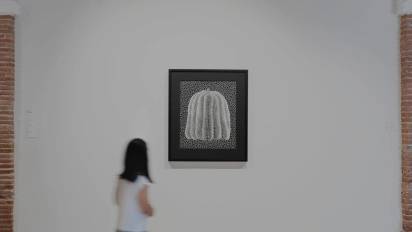
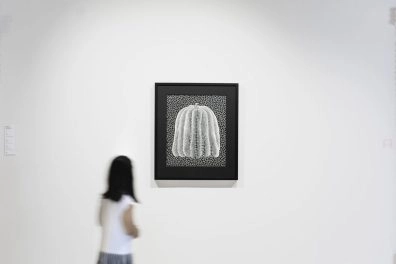
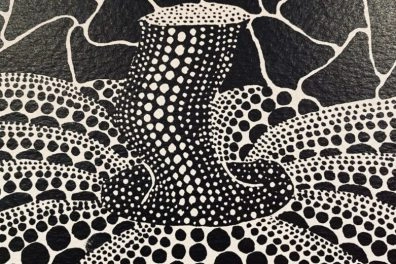
At Moco Museum Amsterdam that transformation can currently be experienced through Pumpkin (white) from 2010. The monochrome work measures 53.7 × 45.2 cm and is currently presented on the first floor.
Without the bright colours often associated with Kusama’s pumpkins, something else comes forward: line, pattern and repetition.
You recognise the pumpkin first.
Then its surface begins to take over.
What Is the Artistic Significance of Kusama’s Pumpkin Motif?
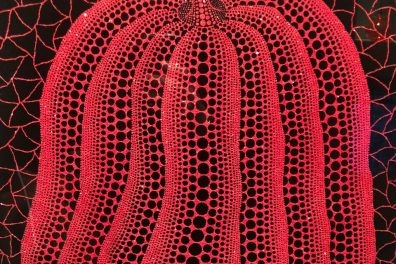
The artistic significance of Yayoi Kusama’s pumpkin motif lies in the way she combines a personal and familiar object with repetition, pattern and polka dots. The pumpkin became a recurring form through which Kusama could explore ideas central to her wider practice while creating a visual language that audiences could immediately recognise.
Repetition is essential to understanding why the pumpkin matters.
Kusama’s dots appear across paintings, sculptures, installations and other surfaces. Within her wider practice, repetition creates a visual language that moves between control and intensity, individual forms and seemingly endless patterns.
The pumpkin makes those ideas tangible.
Look at Pumpkin (white) and the object never completely disappears. You still see its rounded body and familiar shape. Yet the repeated marks begin to compete for your attention. They create rhythm across the surface and change the way volume is perceived.
This relationship between something familiar and something seemingly endless appears throughout Kusama’s wider practice.
Dots multiply. Nets expand. Reflections continue beyond the apparent boundaries of a room.
The pumpkin gives that visual language a body.
Why Are Kusama’s Pumpkins Covered in Polka Dots?
Kusama’s polka dots are much bigger than decoration.
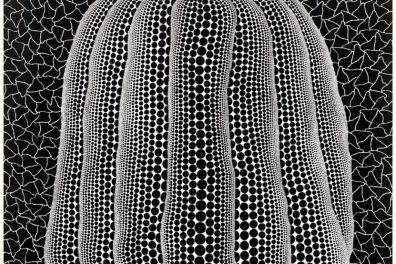
Across her work, repetition can destabilise the boundaries of a single object. One dot becomes many. A pattern spreads across a surface. In immersive environments, repetition can extend across an entire space.
With the pumpkins, this language meets an organic form.
The dots follow the pumpkin’s curves rather than simply sitting on top of them. Shape and pattern become inseparable. That is part of what makes the motif so recognisable: Kusama takes something almost everyone knows and makes it unmistakably hers.
Her approach also connects the pumpkin to recurring ideas of infinity and self-obliteration within her wider practice. Repeated patterns, infinity nets and immersive environments became central elements of an artistic language concerned with identity and the relationship between the self and something much larger.
The pumpkin may be finite.
The pattern suggests otherwise.
Who Is the Artist Known for Polka-Dotted Pumpkins?
Yayoi Kusama is the Japanese artist known worldwide for polka-dotted pumpkins. Pumpkins became one of the most recognisable motifs in her practice, alongside her Infinity Nets, polka dots and immersive installations.
Visitors who want to discover more about the artist behind the polka-dotted pumpkins can explore Yayoi Kusama in Amsterdam and her wider artistic practice.
Kusama developed a visual language that could move between radically different forms while remaining recognisable.
A pumpkin. A painting. A room. A sculpture.
Repetition connects them.
This consistency helps explain why the pumpkin became more than a recurring subject. It became a visual shorthand for Kusama herself.
But reducing Kusama to pumpkins and dots misses what makes that language interesting.
The same repeated forms that can appear playful can also raise questions about identity, perception, control and infinity. What looks accessible on first encounter can become psychologically complex the longer you stay with it.
That combination is part of the power.
You do not need an art history degree to recognise a Kusama pumpkin.
There is still much more to discover once you do.
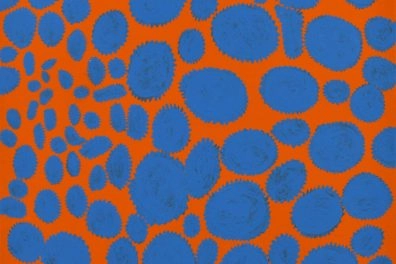
From Pumpkin to Infinity
The pumpkin makes even more sense when seen alongside Kusama’s wider artistic practice.
Her Infinity Nets use repeated marks to create surfaces that seem capable of continuing beyond the canvas. Her immersive installations use mirrors, light and repetition to challenge where the artwork ends and the viewer begins.
The scale changes, but the underlying questions remain connected.
How far can a pattern continue?
When does repetition stop feeling controlled?
What happens to an individual object when its entire surface becomes part of a larger visual system?
This is where Kusama’s pumpkin moves beyond an instantly recognisable image.
It becomes one expression of a much larger way of seeing.
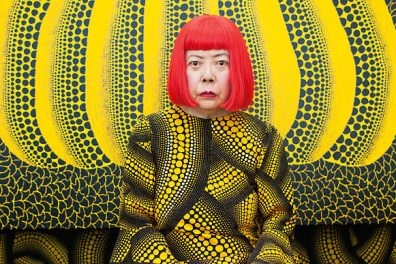
See Yayoi Kusama’s Pumpkin in Amsterdam
Visitors can currently see Yayoi Kusama’s Pumpkin (white), 2010, at Moco Museum Amsterdam on Museumplein. The work is shown within Moco’s Modern Masters context, alongside artists who helped transform modern and contemporary visual culture.
Pumpkin (white) offers a quieter encounter with Kusama’s famous motif.
Rather than relying on vibrant colour, the work brings attention back to the relationship between form and pattern. Its restrained palette makes the repetition easier to follow across the pumpkin’s surface.
It is also not the only Kusama work currently presented at Moco Amsterdam.
The updated selection includes Hi, Konnichiwa (Hello)! Goro, a bright pink dog covered in green polka dots, and a suite of three limited edition skateboard decks from 2014.
Together, they reveal how Kusama’s visual language moves.
The pumpkin feels controlled and rhythmic. Goro turns pattern into a playful sculptural presence. The skateboard decks move that language onto objects associated with movement and street culture.
Different objects. Different moods.
Still unmistakably Kusama.
Moco Museum Amsterdam presents these works within Modern Masters placing Kusama within a wider conversation about artists whose ideas transformed modern and contemporary visual culture.
Moco Museum is an independent modern and contemporary art museum with locations in Amsterdam, Barcelona and London, presenting modern, contemporary, digital, immersive and street art through accessible and emotionally engaging experiences.
For visitors interested in exploring that wider context, Moco Amsterdam also offers a dedicated introduction to the city’s modern art museum experience.
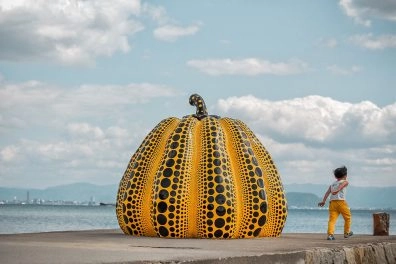
Are There Kusama Pumpkin Exhibitions in Amsterdam Right Now?
Yes. As of 1 October 2026, Moco Museum Amsterdam is presenting Yayoi Kusama’s Pumpkin (white), 2010, within its current Kusama presentation and Modern Masters context. The work is currently on exhibit on the first floor.
Amsterdam also currently offers another way to explore Kusama’s practice.
The Stedelijk Museum Amsterdam is presenting a major retrospective devoted to Kusama until 17 January 2027. Conceived during her lifetime, the exhibition looks across decades of her practice.
The Stedelijk retrospective and Moco presentation offer different perspectives. The retrospective provides a broad view across Kusama’s career, while Moco places selected works within a wider modern and contemporary art context.
Both museums are located on Museumplein, making it possible to experience these complementary perspectives during the same day.
Because temporary exhibition programmes can change, visitors should check each museum’s current programme when planning a future visit.
Why the Pumpkin Endures
There is a reason the pumpkin survives endless reproduction without losing its connection to Kusama.
It is simple enough to recognise immediately and complex enough to keep changing.
Kusama could alter its scale, colour, surface or context. She could translate the motif between two and three dimensions. Yet the relationship between organic form and repeated pattern remained.
That makes the pumpkin both personal and universal.
It began with something familiar to Kusama.
It became familiar to the world.
And somewhere between those two points, an ordinary vegetable became one of contemporary art’s most recognisable forms.
Moco Staff Pick: Pumpkin Spice After the Pumpkin
After seeing Pumpkin (white), autumn offers an obvious continuation.
Mehal from Moco recommends Waldo in De Pijp for a pumpkin spice latte. For an extra autumn moment, pair it with their pecan pie.
It is a small seasonal detour after an encounter with one of art’s most famous pumpkins.
Yayoi Kusama Pumpkin FAQ
Why are Yayoi Kusama’s pumpkins famous?
Yayoi Kusama’s pumpkins are famous because they combine a deeply personal motif with her instantly recognisable visual language of dots and repetition. Their familiar organic shape became a recurring way for Kusama to explore pattern, perception and ideas connected to her wider practice.
What do pumpkins represent in Yayoi Kusama’s art?
Within Moco Museum’s interpretation of Kusama’s work, pumpkins connect to comfort, stability and personal history. Familiar to Kusama from childhood, the pumpkin became a recurring motif that she transformed through pattern and repetition.
Why did Yayoi Kusama put dots on pumpkins?
Kusama used repeated dots as part of a visual language that runs throughout her practice. On pumpkins, repetition changes how we experience the familiar organic form, turning its surface into rhythm and pattern.
Who is the artist famous for polka-dot pumpkins?
Yayoi Kusama is the artist famous for polka-dot pumpkins. She is also known for Infinity Nets, immersive installations and repeated patterns exploring ideas including infinity, identity and self-obliteration.
Where can I see a Yayoi Kusama pumpkin in Amsterdam?
As of 1 October 2026, visitors can see Yayoi Kusama’s Pumpkin (white), 2010, at Moco Museum Amsterdam on Museumplein. The work is currently presented on the first floor within Moco’s wider Modern Masters context.
Can I see more Yayoi Kusama art in Amsterdam?
Yes. Moco Museum Amsterdam currently presents Pumpkin (white) alongside Hi, Konnichiwa (Hello)! Goro and three limited edition skateboard decks from 2014. The Stedelijk Museum Amsterdam is also presenting a major Kusama retrospective until 17 January 2027.