1. Fidia Falaschetti: Freaky Mouse (2018)
When something familiar becomes unsettling
There’s something about a familiar cartoon character that makes an unexpected transformation feel even stranger.
Italian contemporary artist Fidia Falaschetti plays with that tension in Freaky Mouse (2018), a sculpture displayed in the garden at Moco Museum Amsterdam
At first glance, the figure recalls the cheerful visual language of childhood cartoons. But its distorted appearance interrupts that sense of familiarity.
Falaschetti’s practice combines commercial imagery and pop culture with satire, irony and social commentary. His work challenges the things we admire, buy and consume, sometimes making us smile while asking uncomfortable questions.
Freaky Mouse captures that contradiction. It is playful, recognisable and slightly unsettling at the same time.
Amsterdam staff pick: Freaky Mouse
An Amsterdam staff pick for this Halloween-inspired trail is Freaky Mouse.
The appeal begins with its funny name, but there’s more to it. We all recognise the familiar image of Mickey Mouse. Inside the museum, visitors encounter Damien Hirst’s colourful interpretation of Mickey. Outside, Falaschetti presents a radically different, distorted version of that familiar character.
Seeing the two works in one visit makes the contrast especially memorable.
The seasonal connection is an editorial one: Freaky Mouse isn’t presented as Halloween art. It simply captures that strange moment when something comforting becomes unexpectedly unfamiliar.
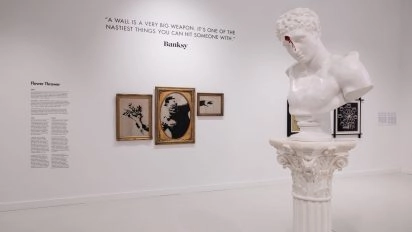
2. Banksy: Grin Reaper (2005)
When death wears a smile
A skeleton holding a scythe is an image many people associate with death. But what happens when the face beneath the hood is replaced by a bright yellow smiley?
In Grin Reaper (2005), Banksy transforms one of the most recognisable symbols of mortality into something unexpectedly playful.
The skeletal figure sits on a large clock, with a smiley face inspired by 1990s rave and acid house culture. The clock resembles London’s Big Ben and reads five minutes to midnight.
That detail matters. Midnight becomes a metaphor for approaching catastrophe, while the smiley mask introduces an uncomfortable contrast between danger and amusement.
The result is dark humour with a sharper edge.
Banksy’s work invites reflection on mortality, our relationship with danger and the absurdity of modern life. The smile doesn’t remove the threat. It makes the image more unsettling.
Of all the works on this trail, Grin Reaper has perhaps the most direct visual connection to Halloween. Yet its meaning reaches beyond the season, asking why we sometimes respond to serious threats with detachment or humour.
Discover more of Banksy’s social commentary in the <a href=”https://www.mocomuseum.com/exhibitions/amsterdam/banksy-exhibition-amsterdam/”>Banksy exhibition in Amsterdam</a>.
3. Damien Hirst: Mickey (2016)
A familiar face, transformed
Not every surprising artwork needs to be frightening.
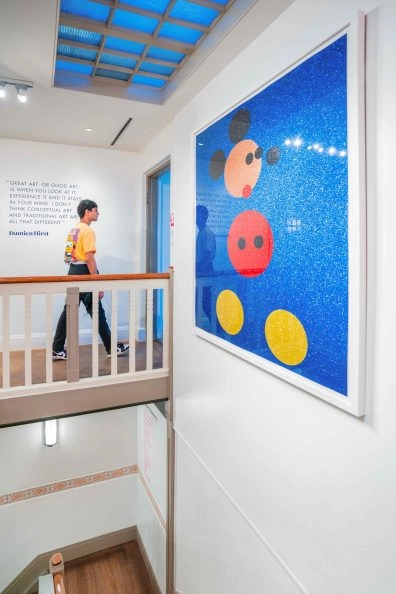
In Mickey (2016), Damien Hirst reimagines one of the world’s most recognisable cartoon characters using just twelve dots in four colours.
The composition is remarkably simple. Yet the image remains instantly familiar.
Inspired by Pointillism, Hirst uses separate dots to create a larger image, reducing Mickey Mouse to basic visual elements while preserving the character’s identity.
Hirst has described the work as connected to childhood happiness and joy. It shows how a few carefully arranged shapes can carry enormous cultural recognition.
For this Halloween trail, the interest lies in transformation rather than horror.
Seen alongside Falaschetti’s Freaky Mouse, Hirst’s artwork raises an intriguing question: how far can an artist change something familiar before it becomes something else?
The contrast between the two works turns a recognisable childhood icon into a conversation about imagination, memory and the power of images.
4. KAWS: Monster (2019)
The strange creatures of contemporary pop art
A monster doesn’t always need sharp teeth or a frightening face.
Sometimes, it can be soft, colourful and strangely inviting.
In Monster (2019), KAWS brings together cartoon-inspired imagery and contemporary design through a collaboration with Estudio Campana.
The work belongs to a series of sculptural furniture pieces created from accumulations of plush cartoon characters, recognisable through KAWS’s signature crossed-out eyes.
The collaboration transforms familiar materials into something unexpected. Childhood imagery becomes a sculptural object that sits between art, design and popular culture.
KAWS frequently draws on recognisable cartoon forms, using them to explore nostalgia, memory and the emotional connections people form with familiar characters.
For an October art trail, Monster offers a playful contrast to the darker imagery of Banksy’s Grin Reaper.
Its Halloween connection comes from its creature-like appearance and unexpected transformation of familiar forms, rather than an established horror theme.
5. Jean-Michel Basquiat: Figure Portfolio (1982)
Figures that refuse to stay still
Some artworks feel intense not because of what they depict, but because of how they communicate.
In Figure Portfolio (1982), Jean-Michel Basquiat uses vivid colour, energetic marks, words, symbols and layered imagery to create compositions that resist simple interpretation.
The portfolio includes five hand-pulled screenprints featuring figures surrounded by Basquiat’s distinctive visual language.
His work brings together references to ancestry, modernity, identity and society. The figures appear within complex arrangements of marks and signs, suggesting ideas that unfold the longer you look.
Basquiat’s compositions can feel spontaneous and restless. Their rough, unrefined quality challenged conventional expectations of artistic beauty and representation.
For this seasonal route, Figure Portfolio introduces a different kind of unexpected encounter.
Rather than linking the work to horror, the Halloween lens draws attention to its intensity, fragmented forms and the feeling of confronting images that cannot be understood in a single glance.
The artwork’s meaning remains rooted in Basquiat’s artistic practice, not in the seasonal association.
Explore more influential artists in <a href=”https://www.mocomuseum.com/exhibitions/amsterdam/modern-masters-amsterdam/”>Modern Masters at Moco Amsterdam</a>.
6. Yayoi Kusama: Pumpkin (White)
A Halloween symbol, seen differently
What would Halloween be without a pumpkin?
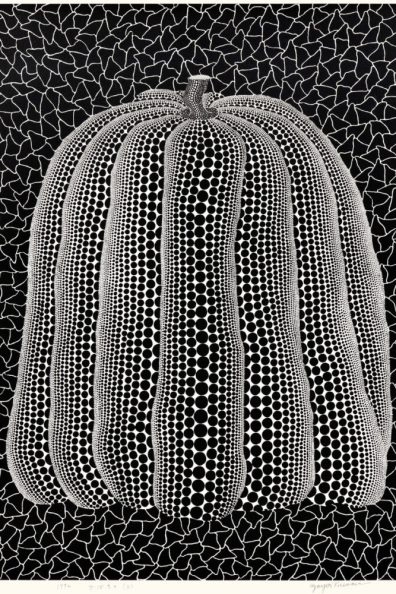
In Pumpkin (White), Yayoi Kusama transforms this familiar vegetable into an intricate arrangement of dots and repeating patterns.
The black-and-white pumpkin sits against a patterned background, creating a visual rhythm that feels almost endless.
Pumpkins and polka dots have been recurring elements throughout Kusama’s artistic practice. Her fascination with pumpkins connects to childhood memories, while her use of repetition and nets explores ideas of infinity and perception.
Unlike the carved pumpkins associated with Halloween, Kusama’s work doesn’t rely on frightening imagery.
Instead, it invites visitors to reconsider an everyday object through repetition, pattern and personal symbolism.
That makes it a natural final stop on this October trail: a seasonal symbol that becomes something entirely different through art.
Kusama’s pumpkin motif has a much deeper significance within her practice, extending far beyond its association with October.
Why This Is an Unusual Halloween Activity in Amsterdam
Moco Museum Amsterdam offers a Halloween-inspired cultural activity through its existing collection, including artworks by Banksy, Damien Hirst, KAWS, Jean-Michel Basquiat, Fidia Falaschetti and Yayoi Kusama. The collection trail is an editorial interpretation, not a separate Halloween exhibition.
Halloween often encourages us to explore what feels strange, mysterious or unfamiliar.
Art can do something similar.
Banksy uses a smiling Grim Reaper to question mortality. Falaschetti transforms a familiar cartoon character into an unsettling figure. KAWS makes a monster playful, while Basquiat’s expressive compositions invite closer attention.
Hirst and Kusama show how ordinary, recognisable images can become extraordinary through artistic transformation.
Together, these works offer an alternative to traditional Halloween activities in Amsterdam. No haunted house required. Just curiosity and a willingness to see familiar things differently.
Visitor Information
Moco Museum Amsterdam is located near Museumplein and is open daily throughout October 2026.
| Dates | Opening hours |
| 9 October – 8 November 2026 | Daily, 9:00 AM – 8:00 PM |
All exhibitions remain available during evening opening hours. For the fullest experience, plan to arrive at least 45 minutes before the final available time slot. Check the official booking website for admission times and ticket availability.
The artworks featured in this trail are marked as on show in the supplied October 2026 collection inventory. Displays may change, so check current exhibition information before your visit.
This October, Discover the Unexpected at Moco Amsterdam
Some artworks make you smile. Others make you think. A few manage to do both while leaving you feeling slightly unsettled.
This Halloween, explore the unexpected side of modern and contemporary art at Moco Museum Amsterdam.
Moco Museum is an independent modern and contemporary art museum with locations in Amsterdam, Barcelona and London. Across its museums, Moco makes modern, contemporary, digital, immersive and street art accessible through experiences that invite curiosity, reflection and emotional connection.
In Amsterdam, discover familiar faces transformed, unexpected creatures and artworks that challenge the way we see the world.
Make art part of your October plans.
Frequently Asked Questions
What can you do in Amsterdam for Halloween besides parties?
For an alternative Halloween activity in Amsterdam, visit Moco Museum Amsterdam and explore a seasonal trail through existing artworks that connect with themes of mortality, satire, unusual imagery and transformation. The museum is not presenting these works as a dedicated Halloween exhibition.
Does Moco Museum Amsterdam have a Halloween exhibition?
No. This article offers a Halloween-inspired interpretation of artworks already on display at Moco Museum Amsterdam. The selected works were not created specifically for Halloween.
Which artworks at Moco Museum Amsterdam have darker or unusual themes?
Banksy’s Grin Reaper explores mortality through dark humour, while Fidia Falaschetti’s Freaky Mouse uses a distorted familiar character to provoke reflection. Other works on this trail explore transformation, visual intensity and unexpected interpretations of popular imagery.
Can I see Yayoi Kusama's pumpkin at Moco Museum Amsterdam?
Yes. Pumpkin (White) is marked as on display in Moco Museum Amsterdam’s October 2026 collection inventory. Exhibitions and displays can change, so check the latest museum information before visiting.
Is Moco Museum Amsterdam suitable for an October cultural outing?
Yes. Moco Museum Amsterdam presents modern, contemporary, street, digital and immersive art, offering an alternative cultural activity for visitors exploring the city in October.