More Yayoi Kusama at Moco Amsterdam
Kusama’s dots are instantly recognisable. But repetition in her work was never simply repetition.
Across pumpkins, sculptural figures and unexpected surfaces, familiar motifs change as their scale, colour and context shift. The updated presentation at Moco Amsterdam offers another way into this visual universe through three very different encounters.
The updated Yayoi Kusama presentation at Moco Museum Amsterdam brings together Pumpkin (white), Hi, Konnichiwa (Hello)! Goro, and a suite of limited edition skateboard decks from 2014.
Together, the works demonstrate the breadth of a visual language that Kusama developed and revisited throughout her career.
Pumpkin (white), 2010
Few forms are as closely associated with Yayoi Kusama as the pumpkin.
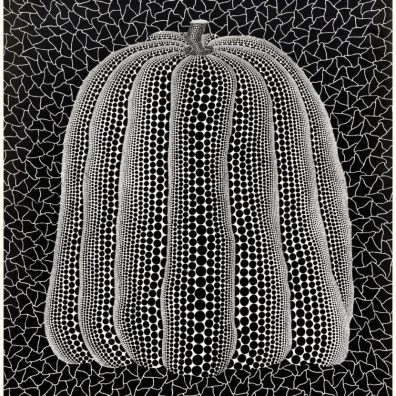
At Moco Museum Amsterdam, Pumpkin (white), dated 2010, offers a monochrome encounter with one of her most recognisable motifs. Measuring 53.7 × 45.2 cm, the work is currently on show on the first floor.
Its impact comes from the tension between something ordinary and something transformed. A familiar organic form becomes a field of repetition. The pumpkin remains recognisable, yet pattern changes how we experience its surface, volume and rhythm.
Across Kusama’s wider practice, the pumpkin became one of the recurring forms through which her distinctive visual language could be recognised. Here, the absence of bright colour draws attention towards line, pattern and repetition.
The result is restrained but absorbing. You recognise the object first. Then the surface begins to take over.
Encountering Hi, Konnichiwa (Hello)! Goro
Another work creates a very different presence.
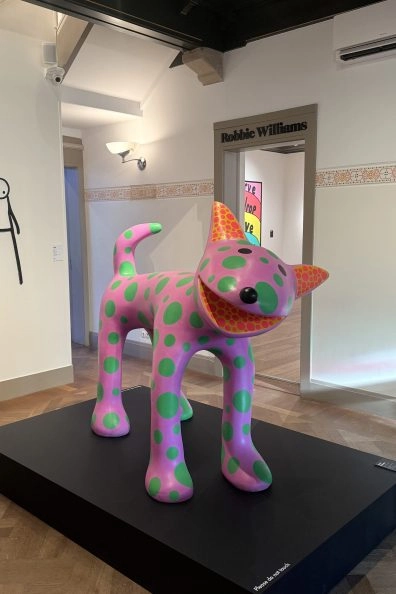
A bright pink dog covered in green polka dots stands in the gallery with its mouth open and ears raised. Hi, Konnichiwa (Hello)! Goro takes a familiar living form and draws it into Kusama’s visual universe through colour, pattern and repetition.
There is a sense of warmth and playfulness in the encounter, qualities that sit comfortably beside the intensity and discipline of Kusama’s repeated forms.
Seen alongside Pumpkin (white), the work also demonstrates how the same artistic language can produce very different experiences.
One feels quiet and rhythmic. The other fills the room with an exuberant physical presence.
Together, they reveal the range within a practice that remained unmistakably Kusama’s.
Kusama’s Visual Language Across New Forms
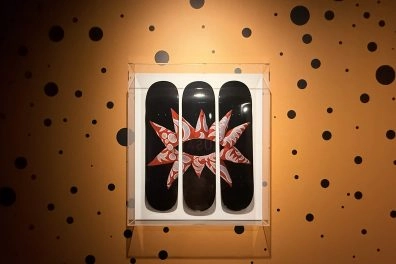
Three skateboard decks reveal another expression of that language.
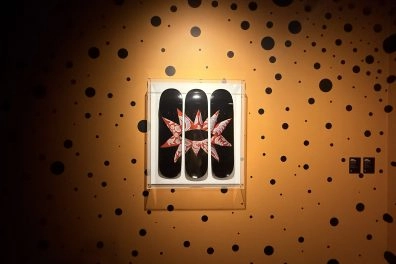
The 2014 suite brings Kusama’s imagery onto three skateboard decks, shifting her distinctive visual vocabulary onto an object associated with movement and street culture.
Placed together, the boards become a single visual composition. Their elongated forms create a rhythm across the wall, showing how Kusama’s approach to pattern could move between very different surfaces and contexts.
Seen alongside Pumpkin (white) and Hi, Konnichiwa (Hello)! Goro, the work speaks to the breadth of an artistic practice developed across decades.
A pumpkin. A sculptural figure. Three skateboard decks.
Each begins with something recognisable. Each is transformed through Kusama’s approach to repetition, pattern and visual rhythm.
Today, these works inevitably carry additional resonance. Kusama died in Tokyo on 14 August 2026 at the age of 97. According to her studio, she continued painting until her final days, remaining committed to an artistic practice that had occupied almost an entire lifetime. (AP News)
Her absence changes the context in which we now encounter the work. The dots, pumpkins and repeated forms remain, but they also become part of the legacy of an artist who devoted her life to creating a visual world entirely her own.
A Moment to Reflect on Kusama in Amsterdam
The updated presentation arrives at a significant moment for Amsterdam.
The Stedelijk Museum Amsterdam is presenting a major retrospective devoted to Kusama. What was conceived as a retrospective during her lifetime now has added significance following her death. The exhibition looks across decades of her practice, while Moco offers visitors another encounter through selected works presented within a wider modern and contemporary art context.
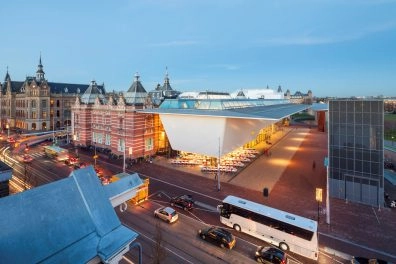
The Stedelijk Museum Amsterdam and Moco Museum Amsterdam are both located on Museumplein, allowing visitors to experience two complementary perspectives on Yayoi Kusama during the same day.
There is no need to position one experience against the other.
A retrospective can trace the development of an extraordinary career. A focused encounter can invite you to spend more time with individual works and notice how a familiar visual language changes across different forms.
For those visiting Amsterdam because of Kusama, experiencing both offers an opportunity to continue looking.
From Dots to a Lasting Legacy
What makes these works compelling together is not simply that they share a famous artist.
Kusama developed a visual language capable of moving between painting, sculpture, installation and objects while remaining immediately recognisable. Repetition became one of the defining characteristics of that language. Dots multiplied. Forms returned. Surfaces seemed to continue beyond their physical boundaries.
Kusama continued working until the end of her life. Her studio described that commitment in announcing her death, saying that she never set aside her brush and continued exploring ideas of love and eternity through her art.
That lifelong dedication gives encounters with her work a different weight today.
At Moco, her works become part of a wider conversation about artists who changed visual culture and developed new ways for audiences to experience art.
Moco Museum is an independent modern and contemporary art museum with locations in Amsterdam, Barcelona and London. Across its museums, Moco presents modern, contemporary, digital, immersive and street art through accessible and emotionally engaging experiences.
In Amsterdam, that conversation takes place inside Villa Alsberg on Museumplein, where different generations of artistic ideas meet within one setting.
Kusama’s life has ended. The encounter with her art continues.
Frequently Asked Questions
Where can I see Yayoi Kusama in Amsterdam?
Yayoi Kusama’s work can be experienced at Moco Museum Amsterdam, where an updated selection includes Pumpkin (white), Hi, Konnichiwa (Hello)! Goro, and limited edition skateboard decks. The Stedelijk Museum Amsterdam is also presenting a major retrospective of Kusama’s work.
What Yayoi Kusama works can I see at Moco Museum Amsterdam?
The updated selection includes Pumpkin (white), Hi, Konnichiwa (Hello)! Goro, and a suite of limited edition skateboard decks from 2014. Displays at Moco are evolving, so individual works may change over time.
Is Pumpkin (white) on show at Moco Museum Amsterdam?
Yes. Pumpkin (white) by Yayoi Kusama, dated 2010 and measuring 53.7 × 45.2 cm, is currently on show at Moco Museum Amsterdam.
When did Yayoi Kusama die?
Yayoi Kusama died on 14 August 2026 at the age of 97. Her studio said that she continued painting until her final days. (AP News)
What was Yayoi Kusama known for?
Yayoi Kusama was known for a distinctive visual language built around repetition and recurring motifs, particularly polka dots. Her long career encompassed painting, sculpture, installation, performance and other forms of artistic expression. (AP News)
Can I visit the Stedelijk Museum and Moco Museum Amsterdam on the same day?
Yes. Moco Museum Amsterdam and the Stedelijk Museum Amsterdam are both located on Museumplein, making it possible to experience two different perspectives on Yayoi Kusama during the same day.
Are the Yayoi Kusama works at Moco permanent?
Moco Museum Amsterdam has an evolving collection, and individual artworks may rotate over time. Visitors should check the current presentation when planning a visit.
Visiting Moco Museum Amsterdam
Moco Museum Amsterdam is located in Villa Alsberg on Museumplein in Amsterdam.
Location: Honthorststraat 20, 1071 DE Amsterdam
Experience: Modern, contemporary, street, digital and immersive art
Good to know: Moco’s presentation evolves, so individual artworks may rotate over time.
Continue Your Encounter with Kusama at Moco
Yayoi Kusama leaves behind an extraordinary body of work and a visual language recognised around the world.
This autumn, Amsterdam offers a timely opportunity to spend time with that legacy. Explore Kusama’s retrospective at the Stedelijk, then continue across Museumplein to encounter selected works at Moco.
From the controlled repetition of Pumpkin (white) to the vivid presence of Hi, Konnichiwa (Hello)! Goro and the transformation of skateboard decks, each work offers another perspective on an artist whose commitment to making art endured throughout her life.
Plan your visit to Moco Museum Amsterdam and experience the enduring visual world of Yayoi Kusama.