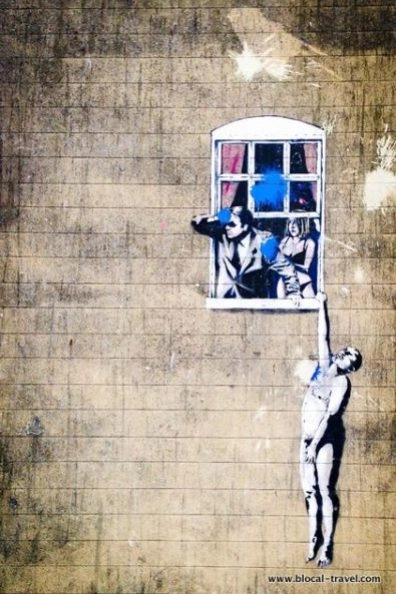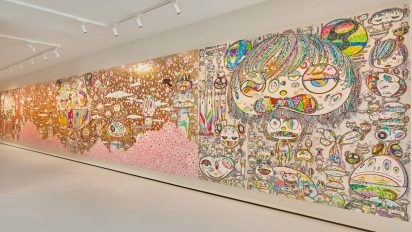
A mural is a format: an artwork made on a wall or another fixed surface. Street art is the broader category, shaped by public space, urban culture, and how people encounter the work. That means one piece can be both a mural and street art at the same time. Graffiti adds another layer, usually linked more closely to writing-led or aerosol-rooted practice.
Why these labels blur so easily
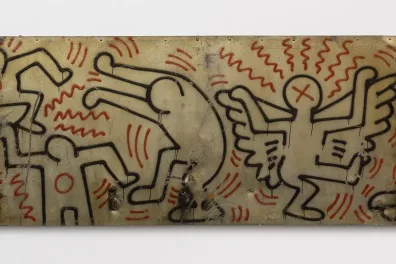
The terms blur because both often appear on large, highly visible surfaces in shared space. Artists also move between street interventions, commissioned public walls, galleries, and museum exhibitions, so the categories are not fixed. Most people notice scale, colour, or message first, while the label depends more on context, intent, and background than on size alone.
What actually counts as street art?
Street art is not one technique, and it does not mean every painted wall. It is a broad urban-art category that can include stencils, paste-ups, posters, murals, installations, sculpture, and works later shown as prints or museum pieces. Legality can affect how a work is perceived, but street art is also defined by visual language, public setting, and its relationship to the city. At Moco Museum, street art-linked artists show how this identity can extend beyond the street.
Common types of street art you’ll spot in public space
- Stencils: repeated images or text sprayed or painted through a cut-out template.
- Paste-ups and posters: printed works attached to walls, boards, or other surfaces.
- Murals: larger painted works made directly onto a wall or façade.
- Stickers: small repeatable interventions spread across urban surfaces.
- Installations: objects, sculpture, or altered street elements placed in public view.
What makes a mural a mural?
A mural is defined by its format: a large artwork created directly on a wall, ceiling, façade, shutter, or another fixed surface. Murals can be historic or contemporary, indoors or outdoors, and they may be decorative, symbolic, artistic, or community-led. They are often used for storytelling and place-making, and they also appear in institutional settings. When older painted surfaces survive, restoration becomes part of the discussion too.
Street art, murals and graffiti at a glance
| Term | What it describes | Typical clues | Can it overlap? |
|---|---|---|---|
| Street art | A broader public-art or urban-art context | Public setting, imagery, intervention, varied media | Yes, it can include murals and some graffiti-rooted work |
| Mural | A wall-based format | Directly painted on a fixed surface, often large-scale | Yes, a mural can also be street art |
| Graffiti | Writing-led or graffiti-rooted practice | Tags, letterforms, aerosol style, name-based expression | Yes, some works share techniques or artists with street art |
When one artwork fits more than one label
A mural can also be street art when it comes from street-art culture or functions as a public intervention, not just decoration. Many artists with graffiti or street-art roots now create commissioned walls, so format and artistic origin do not always match neatly. A permitted work is not automatically outside street art, and an unsanctioned work is not automatically graffiti. Style, intent, setting, and artist identity all matter.
Banksy shows why the categories overlap
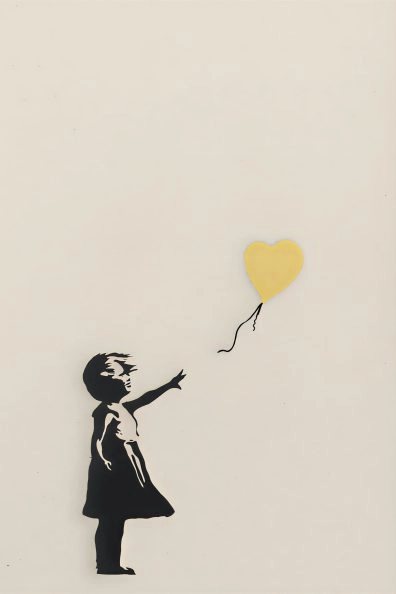
Banksy is a useful example because technique and category are not the same thing. His stencil-based public works are widely discussed as street art, and some pieces may also be described as murals when the format fits. Graffiti roots still matter, but not every Banksy work is best labelled graffiti. Because his public works are often protected, removed, or exhibited, they also show how street art can retain its identity beyond the street. At Moco Museum, museum presentations of Banksy help make that overlap visible.
A simple way to choose the right term
- Use mural when the main point is that the work is painted on a wall or fixed surface.
- Use street art when you mean the wider public-art movement or urban context.
- Use graffiti when writing, lettering, or graffiti-rooted aerosol practice is central.
- When precision matters, combine terms: a commissioned mural by a street artist.
- If a work crosses categories, using more than one label is often the most accurate choice.