Why the rat became Banksy’s perfect troublemaker
The rat fits Banksy’s world almost too well. Rats live at the edges of cities, in tunnels, alleys, basements, and gaps in the system. They thrive without permission, survive in hostile conditions, and keep appearing where authorities would rather not see them. For an artist interested in control, public space, social pressure, and who gets pushed aside, that is powerful visual material.
Rats also work because of their scale. They are tiny against walls, buildings, barriers, and institutions. A small stencil on a large surface immediately creates a power imbalance, and that imbalance becomes part of the meaning. The rat is not strong because it dominates. It is strong because it persists. It slips through cracks, returns after removal, and keeps living below the notice of those in charge.
There is also a clear street-art lineage behind the motif. Banksy’s rats are often linked to Blek le Rat, the French stencil pioneer whose urban rats became an important reference point for later street art. People also love the playful link between “art” and “rat,” which adds a layer of myth and wit. But neither of those points fully explains why Banksy kept returning to the image. The rat endured because it could carry attitude, politics, humour, and class tension all at once.
Most importantly, the rat is anti-heroic. It is not noble, glamorous, or monumental. It is scrappy, anonymous, and sharp. That makes it a much better Banksy character than a grand symbol ever could be.
The big ideas hiding inside Banksy’s rats
If you are searching for the core Banksy rats meaning, these are the themes that come up most often:
- Outsider status: Rats often stand in for people who are ignored, disliked, or kept at the edges of public life. They embody life outside approval.
- Resilience: However hostile the environment becomes, the rat keeps going. That makes it a natural symbol of survival under pressure.
- Rebellion: Many rat works carry a defiant energy, as if the smallest figure in the scene is still capable of disrupting authority.
- The power of the overlooked: Banksy’s rats can represent ordinary people, exploited workers, and communities treated as disposable, yet capable of outlasting the systems above them.
- Humour mixed with unease: The rats are often funny, but rarely harmless. Their charm is usually paired with satire, discomfort, or critique.
- No single master key: These themes return again and again, but no one interpretation fits every work. Context always matters.
How props, placement, and scale change the message
The smartest way to read a Banksy rat is to ask what this specific rat is doing here. A placard, tool, costume, caption, or gesture can turn the same animal into a protester, prankster, witness, victim, or saboteur. Placement matters just as much. A tiny rat low on a wall feels different from one centered in a print or framed inside an exhibition. When viewing Banksy in a museum context, including at Moco Museum, that surrounding context becomes part of the reading too.
| Example or cue | What to notice | How the meaning shifts |
|---|---|---|
| Small rat on a large wall | Lots of blank space, low placement, easy to miss at first | The rat feels overlooked but defiant, pushing back from below against something bigger. |
| Placard rats | Signs, slogans, upright posture, public-facing composition | The rat becomes a protester or worker, speaking for people dismissed by authority. |
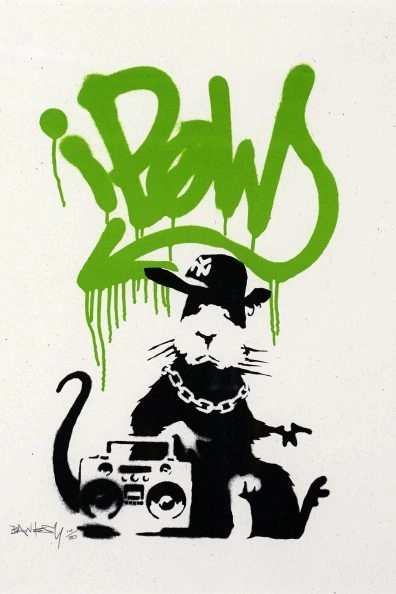
| Gangsta Rat | Swagger, costume-like attitude, music and street-style cues | The image can read as parody, performance, or a comment on rebellion becoming style. |
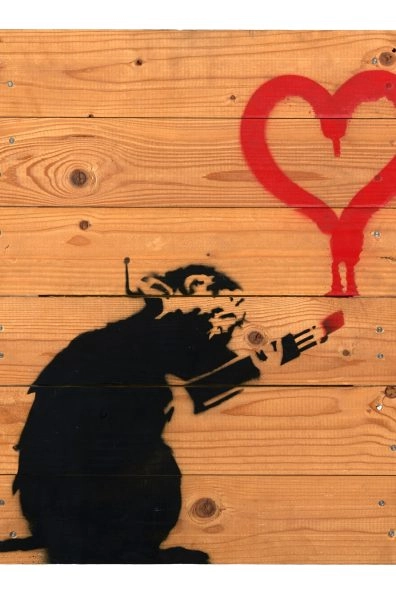
| Love Rat | Heart imagery, softer emotional tone, contrast with urban roughness | The rat shifts toward tenderness, desire, or irony, proving the motif is not only aggressive. |
| Bathroom rats | Cramped domestic setting, mess, motion, comic chaos | The rat becomes a figure of confinement, boredom, and stress, not just street-level rebellion. |
In other words, the rat is not a fixed emblem with one automatic translation. The surrounding scene decides whether it feels playful, political, absurd, or unsettling.
What the rats are really saying about modern life
Banksy’s rats often speak to more than street-art attitude. They tap into wider frustrations about who gets heard, who gets controlled, and who gets left behind. That is why they connect so easily to anti-authority feeling, inequality, consumer critique, and distrust of systems that decide whose lives matter most.
Some works satirize the pressure of everyday life itself. A rat can suggest the so-called rat race: work without dignity, status chasing, branding, competition, and the feeling of being measured by usefulness. In other pieces, the rat seems trapped inside routines or spaces it did not choose, which sharpens the sense of social pressure and reduced freedom.
The motif can also absorb specific moments. The lockdown-era bathroom rats, for example, reflected boredom, confinement, scarcity, and restless energy, while still speaking to a broader frustration many people recognized. That flexibility is the key to their power. Because the rat is ordinary, adaptable, and familiar, Banksy can comment on politics and modern life without reducing the image to a single slogan.
How the motif evolved from stencil to cultural icon
Banksy’s rats have changed over time, but they never lost their recognisable identity. That evolution is a big reason the motif still feels alive.
- Early stencils were simple and immediate: The first rat images often worked through quick visual impact. A small stencil on a public surface already carried the idea of intrusion, survival, and unofficial presence.
- Later rats became more character-driven: Placards, costumes, tools, text, and stronger poses gave the rats clearer roles. They were no longer just signs of presence; they became performers inside mini social dramas.
- Different settings kept the image fresh: One location might push the rat toward protest, another toward parody, menace, absurdity, or even tenderness. That range stopped the motif from becoming repetitive.
- The rat adapted across formats: Street pieces, prints, studio works, and later social-media-era images all used the same recognisable figure while changing the situation around it.
- Its longevity comes from flexibility: The rat can carry private humour, public anger, art-world provocation, or emotional contrast without ceasing to feel like a Banksy rat.
Quick answers to common Banksy questions
Banksy’s rats often lead to bigger questions about his identity, his message, and the quote people return to most. Here are concise answers to the questions most closely connected to the symbolism of the rat motif, with confirmed facts separated from speculation and widely repeated reporting.
What is Banksy’s most famous quote about rats?
The most widely cited Banksy quote about rats comes from Wall and Piece: “They exist without permission. They have no respect for hierarchy. They live where they like. They breed like crazy. They are hated, hunted and persecuted. They are capable of bringing entire civilizations to their knees. If you are dirty, insignificant and unloved then rats are the ultimate role model.”
This quote matters because it turns the rat from an insult into a manifesto. Instead of symbolizing weakness, the rat becomes a model of survival outside approval and official power. It lives without asking to be accepted, which aligns perfectly with Banksy’s interest in resistance, public space, and people on the margins.
It is also useful as a guide, not a complete definition. The quote explains why the rat keeps returning, but it does not flatten every artwork into one meaning. A placard rat, a swaggering rat, and a trapped rat can still say very different things.
How does Banksy get paid if nobody knows who he is?
An anonymous artist can still earn money because public identity is not required for private business. Payments can be handled through galleries, publishers, agents, dealers, auctions, and other intermediaries. For Banksy works especially, provenance and authentication are important, particularly for prints and secondary sales. In short, representation and verification handle the commercial side, even when the artist remains publicly anonymous.
What is Banksy’s main message?
There is no single sentence that explains every Banksy work, but the strongest themes are consistent. He repeatedly challenges power, exposes hypocrisy, questions authority, and draws attention to people who are ignored, over-managed, exploited, or pushed aside. War, policing, borders, status, branding, inequality, and consumer culture all appear across his work, often filtered through humour and irony rather than blunt lecture.
That tone matters. Banksy’s art is rarely just angry. It is often funny first, then sharper on second look. A visual joke can open the door, and the criticism lands a moment later. This is part of why the work travels so well between public walls, prints, books, and museum spaces: the images feel immediate, but they stay open long enough for interpretation.
The rat condenses many of these ideas into one agile figure. It is not a heroic monument standing above the crowd. It is a small, stubborn underdog surviving inside systems built to exclude it. That makes it ideal for expressing anti-authoritarian thinking, social frustration, and distrust of official narratives.
So what is Banksy’s main message? Broadly, it is that power should be questioned, ordinary people should not be dismissed, and the edges of society often reveal the truth more clearly than the center. The exact meaning changes from work to work, but that socially observant, anti-authoritarian thread runs through much of his art.