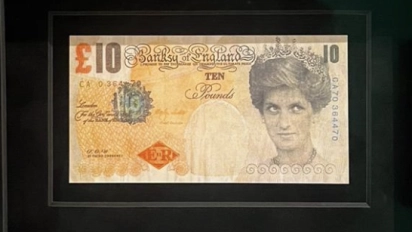
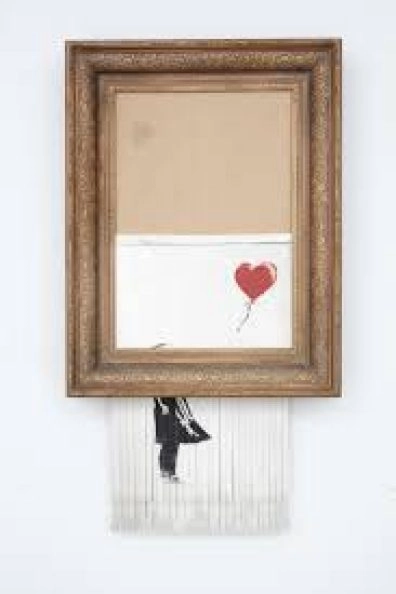
Why Banksy’s pranks resonated far beyond the joke
Banksy’s pranks lasted because the laugh was only the first layer. Behind the joke sat critique of money, power, and cultural gatekeeping. Often the stunt completed the artwork: the reveal and reaction mattered as much as the image. In larger projects, that satire expanded into full experiences.
How the Sotheby’s shred turned a sale into performance art
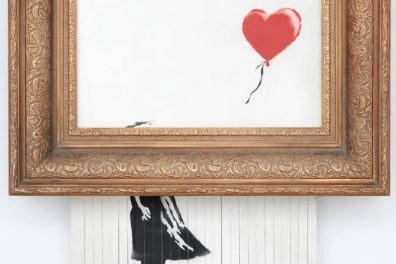
The Sotheby’s shred is Banksy’s clearest merger of auction, image, and performance. A routine sale became live intervention the moment the mechanism activated. Rather than being dismissed as damage, the altered work was renamed Love is in the Bin. Often cited as one of his most controversial works, it still anchors debates about value, authorship, and intent.
What happened when Girl with Balloon sold?
When Girl with Balloon sold, the hammer fell and the work began slipping through a shredder hidden inside its ornate frame. For a few seconds, the room seemed to freeze. Then came gasps, phones, and disbelief as bidders and staff realised the frame itself had been part of the setup.
Why did the painting only half-shred?
Some viewers saw the half-shred as deliberate symbolism, but the later practical explanation is simpler. Banksy released rehearsal footage suggesting the piece was meant to self-destruct completely, yet the mechanism appears to have jammed. Intentional or not, the malfunction gave the stunt an even richer mythology.
Was Sotheby’s in on it?
Suspicion came quickly: how could an auction house miss a device inside such a large frame? Sotheby’s said it did not know, and Banksy’s camp argued collusion would have damaged bidder trust. Beyond those denials, little can be proven, so uncertainty remains part of the work’s afterlife.
Beyond the auction room: the pranks that built Banksy’s legend
The shred mattered because it was not a one-off. Banksy had already turned institutions, landmarks, and crowds into part of the piece. Some interventions were quick and sly, others large and political, but the most influential examples all used surprise to test who controls meaning and legitimacy.
Sneaking into museums to test the gatekeepers
Banksy’s fake additions to the British Museum and Natural History Museum borrowed the authority of trusted institutions. By slipping in a hoax object or rat and letting it stay, he questioned who decides what belongs in a museum. The joke worked as parody, but also as institutional critique.
Turning public spaces into political theatre
In public space, Banksy pushed the prank toward politics. The Disneyland Guantanamo Bay figure, the interventions on the West Bank wall, and the portable-toilet Stonehenge at Glastonbury turned familiar places into sharp stages. Even reports of him painting an East London flower mural became news, exposing the tension between clean-up policy, public opinion, and graffiti’s status as art.
When the prank became an immersive experience
Projects like Crude Oils and Dismaland scaled the prank from a single object to a whole environment. Visitors did not just witness satire; they moved through it. That wider context also matters in museums. At Moco Museum, a visit to the Banksy museum Amsterdam places his work within a broader contemporary art conversation, not only as a street-art headline.
Why Banksy’s anonymity keeps the mystery alive
Banksy’s anonymity strengthens the prank because it shifts attention onto the reveal and the reaction. Identity theories fuel speculation, but speculation is not confirmation. Being seen near a work or linked through rumor is not the same as being definitively identified, and that uncertainty keeps the mystery active.
Has Banksy ever been caught?
An alleged photo of Banksy painting a flower mural in East London drew attention because people wanted visual proof at last. Yet his spokeswoman did not confirm that the person in the image was Banksy. The straightforward answer is no: there is no widely accepted public proof that he has been conclusively caught in the act.
How does Banksy avoid getting caught?
Part of the answer is practical: stencil-based methods let Banksy work quickly. The rest is strategic. Secrecy, limited confirmation, and careful timing all help preserve anonymity. That uncertainty does more than hide him; it turns not-knowing into part of the performance.
