How Are Modern, Contemporary, Digital and Immersive Art Connected?
Modern art challenged traditional ideas about representation, materials and artistic expression. Contemporary art continues that experimentation, responding to the cultural, social and technological conditions of the present.
Digital art extends these possibilities by using technology as an artistic medium.
Artists can create environments through 3D modelling, develop objects that begin as digital concepts, or use animation and computer-generated imagery to explore ideas that would be difficult to express through traditional materials alone.
Immersive art introduces another dimension: the relationship between the artwork, its environment and the visitor.
Although these artistic approaches often overlap, they describe different things.
| Art form | What defines it? |
| Modern art | Artistic experimentation associated broadly with the late 19th to mid-20th centuries |
| Contemporary art | Art reflecting evolving artistic practices and the cultural conditions of the present |
| Digital art | Art created or presented using digital technologies |
| Immersive art | Art designed to surround or spatially involve the visitor |
| Interactive art | Art that responds to or requires visitor participation |
Digital art uses digital technology in its creation or presentation. Immersive art surrounds or spatially involves the visitor. Interactive art responds to participation. An artwork can combine these approaches, but digital art is not automatically immersive, and immersive art is not necessarily interactive.
Understanding these distinctions allows us to look beyond the technology and consider what an artist wants to communicate.
Where Can You Experience Digital and Immersive Art in Barcelona?
One place to explore these connections is located in the historic Palau Cervelló in El Born.
Moco Museum Barcelona is an independent modern and contemporary art museum with locations in Amsterdam, Barcelona and London. Its exhibitions bring together modern, contemporary, street, digital and immersive art through accessible and emotionally engaging experiences.
In Barcelona, visitors can encounter digital artworks alongside other artistic media, making it possible to see how established artistic ideas continue to evolve through new technologies.
The following works are confirmed as On show in Moco’s October 2026 Exhibition Database. Their availability remains subject to exhibition rotation.
Studio Irma: Diamond Matrix and the Art of Human Connection
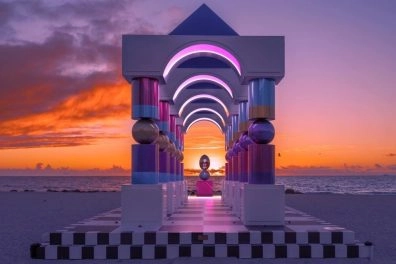
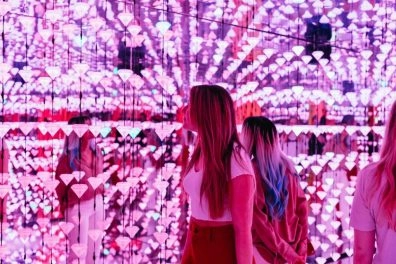
Diamond Matrix by Studio Irma is an immersive digital artwork that explores the relationship between technology, human connection and personal transformation.
Studio Irma, led by Irma de Vries, creates digital immersive experiences, exhibitions and interactive spaces. Its multidisciplinary practice combines augmented reality, videomapping, sculpture, painting and computer animation.
Rather than treating technology as an end in itself, the studio uses colour, space, movement and digital media to encourage connection and optimism.
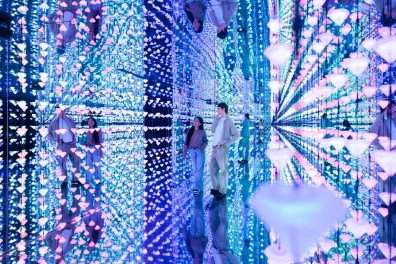
What is the meaning behind Diamond Matrix?
According to Moco’s Mocopedia, Diamond Matrix draws inspiration from the process of transforming diamonds into shining jewels.
The symbolism connects this transformation to human experience.
Life can be difficult and unpredictable, but the challenges we encounter can shape our character and reveal unexpected strengths.
The artwork encourages visitors to reflect on their own experiences and the people who have influenced them.
What should visitors pay attention to?
Notice how the surrounding visual environment affects your perception of space.
Consider how colour, pattern and atmosphere contribute to the experience.
The work is not simply about observing digital imagery. It invites a personal interpretation of transformation, connection and resilience.
Artwork details: Diamond Matrix, Studio Irma. First floor, Sala 12. Recorded as on show in October 2026.
Six N. Five: Digital Landscapes Between Reality and Imagination
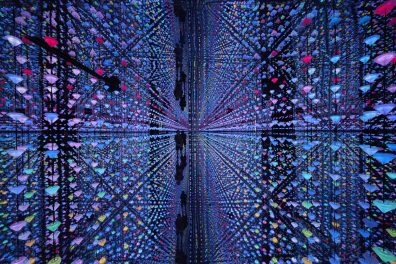
Six N. Five is the creative practice of Barcelona-based Argentinian artist Ezequiel Pini.
Through 3D digital design, Six N. Five creates carefully constructed environments that appear familiar while introducing elements of imagination and abstraction.
The work demonstrates how digital technology can be used to build visual worlds with their own atmosphere, rhythm and emotional character.
Moco’s October 2026 Exhibition Database confirms three works by Six N. Five in Sala 11.
The Circle (2022)
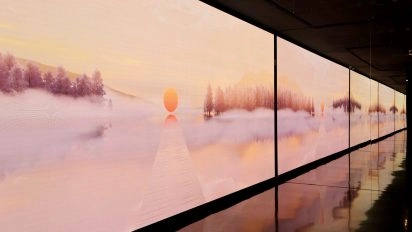
The Circle presents a luminous orange sphere within a digitally constructed landscape.
The composition brings together natural-looking surroundings and a striking geometric form.
Its careful balance of colour, light and space creates a contemplative atmosphere.
Rather than documenting a physical location, the artist constructs an imagined environment through digital processes.
This is what makes The Circle an example of digital art: technology is part of the artwork’s creation, not simply the means by which an existing artwork is reproduced.
Above the Sky (2022)
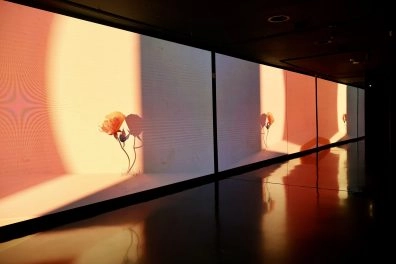
Created by Six N. Five in collaboration with Vhils, Above the Sky presents a digitally imagined architectural environment.
Its pink-toned structures and carefully arranged spatial elements create a world that feels both designed and dreamlike.
The artwork invites viewers to consider how architecture and digital imagery can shape our emotional response to space.
The City (2022)
Also created by Six N. Five and Vhils, The City explores an imagined urban environment.
The work draws on recognisable architectural forms while placing them within a digitally constructed landscape.
Its imagery raises questions about how cities are represented, remembered and reimagined.
Together, these three works demonstrate that digital art can be contemplative rather than interactive. The visitor’s experience comes from observing the visual world and interpreting its atmosphere.
Artwork details: The Circle, Above the Sky and The City (2022). First floor, Sala 11. Recorded as on show in October 2026.

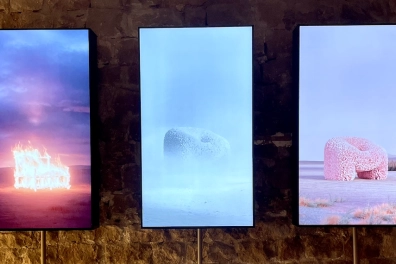
Andrés Reisinger: When Digital Imagination Becomes Physical Art
Barcelona-based artist and designer Andrés Reisinger explores the relationship between reality and fiction through 3D design.
His practice moves between digitally imagined objects, architectural environments and physical design.
This approach challenges a familiar assumption: that an object must exist physically before it can become meaningful.
Hortensia Chair (2021): From Digital Image to Physical Object
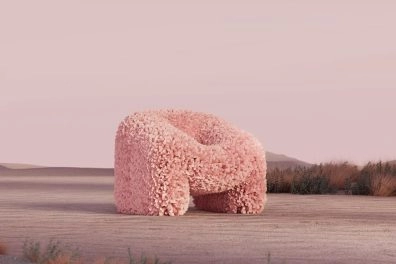
Inspired by hydrangea flowers, Hortensia Chair began as a digital concept.
Moco’s Mocopedia explains that Reisinger first shared a digital version of the chair on social media in 2018.
The image attracted attention and requests from people who wanted to own a chair that did not yet physically exist.
After years of experimentation, the design became a physical object in 2021, developed with Dutch design brand Moooi using approximately 30,000 fabric petals.
The chair illustrates how digital art and design can move beyond the screen.
An imagined object becomes desirable before it becomes physically possible.
The artwork invites visitors to reconsider the relationship between representation, imagination and reality.
More Works by Andrés Reisinger
Moco’s October 2026 Exhibition Database also records Winter Chair (2022), ONE Chair (2021) and Fire (2021).
These works extend Reisinger’s exploration of digital objects and atmospheric imagery.
His creative process is also influenced by music. According to Moco’s Mocopedia, Reisinger immerses himself in different musical genres and translates their emotional qualities into visual sensations.
This relationship between sound, emotion and digital imagery adds another dimension to his practice.
Artwork details: Hortensia Chair, Winter Chair, ONE Chair and Fire. Basement, Sala 00. Recorded as on show in October 2026.
Federico Clapis: Touch in Screen Space and Human Connection
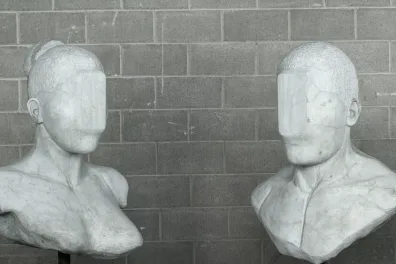
Touch in Screen Space (2021) by Federico Clapis explores the relationship between human contact and digitally mediated environments.
The artwork’s title introduces a question that feels particularly relevant to contemporary life: What happens to human connection when communication increasingly takes place through screens?
One interpretation is that the work invites viewers to reflect on the difference between physical touch and digital presence.
Technology can connect people across great distances, yet the experience of physical closeness remains distinct.
This tension makes the artwork relevant within contemporary art, where artists frequently explore how technological developments affect relationships, identity and everyday life.
Artwork details: Touch in Screen Space (2021), Federico Clapis. First floor, Sala 11. Recorded as on show in October 2026.
Les Fantômes: Endless Parade and the Experience of Movement
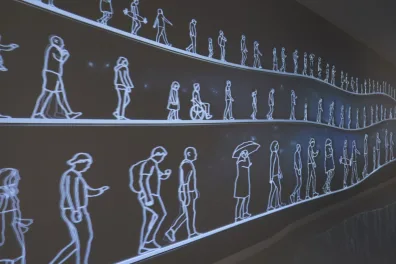
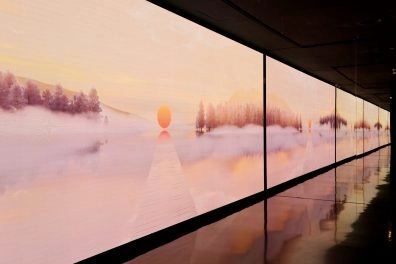
Parade Infinie (Endless Parade) (2021) by Les Fantômes explores movement through an extended visual composition.
The work features a procession of figures presented across a substantial horizontal surface.
Its dimensions, approximately 241 × 1,049 cm, create a different relationship between the artwork and the surrounding architecture.
Rather than encountering a single isolated image, visitors experience a sequence that unfolds across space.
The repeated figures create a sense of continuity, encouraging viewers to follow the movement of the composition.
This demonstrates how scale and presentation can influence the experience of digital art without necessarily requiring direct interaction.
Artwork details: Parade Infinie (Endless Parade) (2021), Les Fantômes. First-floor vestibule. Recorded as on show in October 2026.
Why Digital Art Belongs in a Modern and Contemporary Art Museum
Digital art continues a long history of artists experimenting with new materials, techniques and ways of seeing.
Modern artists challenged conventions around representation and artistic form. Contemporary artists continue to question how art reflects society, technology and human experience.
Digital media offers new ways to explore those questions.
At Moco Museum Barcelona, a digitally imagined landscape by Six N. Five, an immersive environment by Studio Irma and a digitally conceived chair by Andrés Reisinger demonstrate different possibilities within contemporary artistic practice.
These works do not share one visual style or visitor experience.
What connects them is the use of artistic experimentation to reconsider familiar ideas about space, perception, identity and reality.
This relationship between established artistic movements and emerging creative media is central to Moco’s programme.
Explore Moco Museum Barcelona’s digital and immersive art programme to discover how contemporary artists use technology as a medium for creative expression.
Does Barcelona Have a Digital Art Museum?
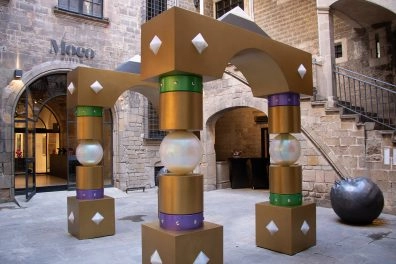
Yes. Visitors interested in digital art museums in Barcelona can experience digital and immersive works at Moco Museum Barcelona. Moco is not exclusively a digital art museum: it is an independent modern and contemporary art museum presenting digital art alongside modern, contemporary and street art.
This broader artistic context helps visitors understand how digital practices connect to the evolution of modern and contemporary art.
The museum’s digital works are not presented simply as technological attractions. They are part of a wider exploration of artistic ideas, creative expression and cultural change.
For practical information about tickets and visiting the museum, explore Moco Museum Barcelona’s visitor information.
Are the Digital and Immersive Artworks Always on Display?
No. Moco Museum Barcelona’s exhibitions evolve over time. The October 2026 Exhibition Database marks the artworks discussed in this article as on show, but individual works may rotate or become temporarily unavailable.
Not all artworks are always on display.
Our collection exhibits artwork on loan and from the Moco Collection. We keep our exhibitions ever-evolving, so every visit is a fresh experience. Occasionally, this means some artworks online are not always on view in the museum. We appreciate your understanding.
Visitors travelling specifically to see one artwork should confirm its availability before visiting.
Frequently Asked Questions
Where can I see digital art in Barcelona?
Moco Museum Barcelona presents digital art by artists including Studio Irma, Six N. Five, Andrés Reisinger and Federico Clapis. Located in El Born, the museum connects digital works with modern and contemporary artistic practices.
Where can I experience immersive art in Barcelona?
Moco Museum Barcelona presents immersive art within its wider contemporary art programme. Studio Irma’s Diamond Matrix is one example recorded as on show in October 2026, subject to rotation.
What is the difference between digital and immersive art?
Digital art uses digital technology as part of its creation or presentation. Immersive art surrounds or spatially involves visitors. Some artworks combine both approaches, but not all digital art is immersive.
Is interactive art the same as immersive art?
No. Interactive art responds to or requires participation, while immersive art creates an environment that involves the visitor. An immersive artwork does not necessarily require interaction.
Where can I see modern art in Barcelona?
Moco Museum Barcelona presents modern art alongside contemporary, digital, immersive and street art. Visitors can explore the relationship between influential modern artistic movements and newer forms of creative expression.
Where can I see contemporary art in Barcelona?
Visitors can explore contemporary art at Moco Museum Barcelona and MACBA, the Museu d’Art Contemporani de Barcelona. Moco connects contemporary art with modern masters, street art and digital experiences, while MACBA focuses on contemporary artistic practices and their cultural contexts.
Is Moco Museum Barcelona suitable for visitors who are new to contemporary art?
Yes. Moco presents modern and contemporary art in an accessible setting, allowing visitors to explore different media and artistic ideas without specialist knowledge.
Plan Your Digital Art Experience at Moco Museum Barcelona
| Information | Details |
| Museum | Moco Museum Barcelona |
| Address | Carrer de Montcada 25, El Born, 08003 Barcelona |
| Monday–Thursday | 10:00–19:00 |
| Friday–Saturday | 10:00–20:00 |
| Sunday | 10:00–19:00 |
| General visit duration | Approximately 60 minutes |
| Artistic programme | Modern, contemporary, digital, immersive and street art |
| Audio tour | Complimentary; bring headphones |
| Tickets | Advance booking recommended |
| Artwork availability | Individual works may rotate |
Opening hours and visitor information may change. Check the museum’s current details before your visit.
Discover How Art Changes with Technology
Technology changes the tools artists use. Art gives those tools meaning.
At Moco Museum Barcelona, digital landscapes can inspire reflection. A chair that begins as a virtual image can become a physical object. An immersive environment can invite visitors to consider the experiences that shape them.
These artworks are part of a wider conversation connecting modern art, contemporary culture and new forms of creative expression.
Inside the historic Palau Cervelló, visitors can discover how familiar artistic questions continue to evolve through different materials, media and perspectives.
Plan your visit and book Moco Museum Barcelona tickets to explore modern, contemporary, digital and immersive art in El Born.