Start with the tension in the scene
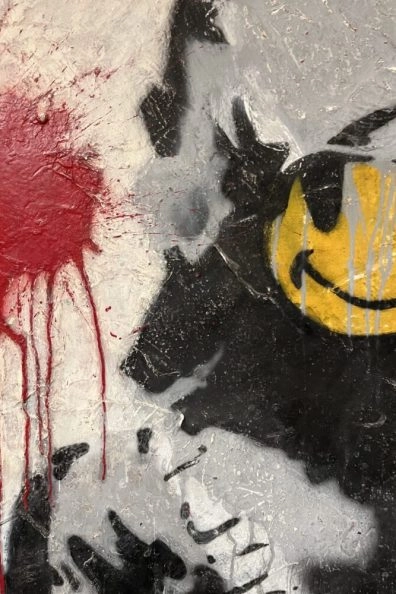
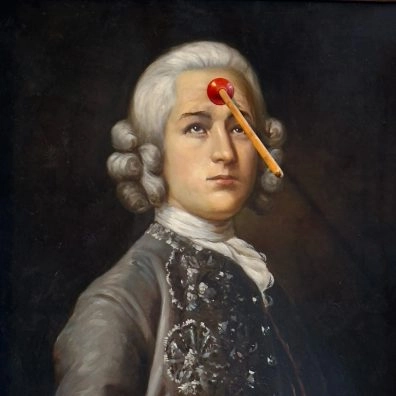
Begin with the plain facts: who or what is shown, what action is taking place, and which familiar object has been turned into a statement. Banksy’s images often work through collision – innocence against control, humor against threat, play against damage. If something feels misplaced, exaggerated, or oddly calm, that is often where the satire begins.
Read the wall, not just the image
A Banksy on a gallery wall is one thing; a Banksy on a prison, courthouse, checkpoint, school, or shop shutter is another. The site is part of the artwork. Public buildings carry rules, memory, and power, so the surface helps tell you who the work is addressing and what it is resisting.
That is why local history matters. The same child, balloon, drone, or security camera can shift meaning once you know the debate, conflict, or cultural reference attached to that place. A scene that first looks simple can become a pointed public comment.
Because street works live in public, their afterlife matters too. Vandalism, protection, restoration, removal, or redevelopment can all change how people read the work. In Banksy’s case, those later reactions often become part of the story about ownership, control, and public memory.
Let the title and the timing do some of the work
If a work has a known title and date, use both as interpretive tools.
- A title can sharpen the joke instead of merely naming the scene. It may redirect attention to a pun, a political target, or an emotional tone, reminding you not to read the image too literally.
- The year matters because Banksy often responds to live events. A mural appearing during a war, a migration debate, or a moment of heightened policing carries a different charge than the same image viewed outside that context.
- Titles and dates also reveal method. Across time, Banksy returns to children, uniforms, consumer symbols, animals, barriers, and damaged walls, using them to test similar public questions in new situations.
- Instead of treating each work as an isolated puzzle, place it on a timeline. When you compare works from different years, repeated concerns and recurring tactics become clearer.
Spot the themes Banksy returns to again and again
Banksy returns to a small set of public concerns. Tracking them helps you move from “what am I seeing?” to “what pressure is being exposed?”
| Theme | Typical visual cues | What it often points to |
|---|---|---|
| War and conflict | Soldiers, drones, riot gear, damaged surfaces, peace symbols in hostile scenes | How violence becomes normalized or disguised |
| Surveillance and state power | CCTV cameras, uniforms, checkpoints, warning signs, fenced spaces | Control, fear, and who gets watched |
| Migration and borders | Boats, barriers, life jackets, crossing gestures, blocked movement | Displacement, exclusion, and unequal freedom |
| Consumerism and class | Shopping bags, logos, luxury references, cash imagery, branded desire | How markets shape status, identity, and public life |
| Environment | Animals, polluted settings, altered landscapes, fragile natural symbols | Human damage and the cost of convenience |
| Childhood as contrast | Children, toys, balloons, school imagery beside weapons or barriers | Innocence set against systems of harm |
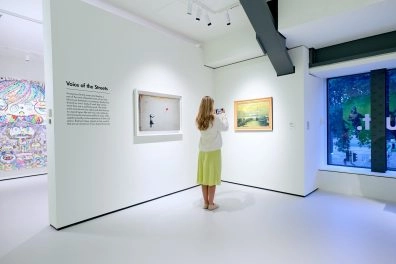
One work can hold several themes at once, which is why side-by-side comparison is so useful. Curated Banksy pages at Moco Museum can also help you spot these repeated patterns faster.
Why stencils, speed, and anonymity matter
Banksy’s crisp edges are closely tied to stencil making: designs can be prepared in advance and applied quickly in public space. That speed helps explain the surprise of the work. Anonymity matters too. It is not just practical protection; it adds risk, urgency, and public impact to the image itself.
Separate meaning from authenticity
- Meaning asks what the image says; authenticity asks what the object is.
- An original street mural, an authenticated print, and a copied image online are different things.
- For prints, provenance, edition details, and Pest Control documentation matter more than a signature.
- For murals, official posts, release videos, and reliable documentation help; a Banksy-like style or signature alone proves very little.
Understand why Banksy’s images have value
Value changes sharply depending on whether you are looking at a public mural, an authenticated print, or an unauthorized reproduction. Rarity, edition size, condition, provenance, and cultural visibility all affect what collectors may pay. High prices attract fakes and headlines, but market value and cultural meaning are related without being identical.
Try the method on Create Escape
Try the sequence on Create Escape. First, name the visible elements: an escaping prisoner, a rope of bedsheets, and a typewriter that turns the scene into a literary clue. Then add the site. On Reading Prison, the image immediately connects to Oscar Wilde, who was imprisoned there, so escape becomes personal, historical, and political at once. The title sharpens the idea, later authentication anchored the work more firmly, and debates around preservation and fundraising added further meaning. Use the same order on other works: image, wall, title, timing, then afterlife.