That is why the piece still carries such force. It turns destruction into creation and asks uncomfortable questions at the exact point where art, money, and spectacle meet. Who decides what an artwork is worth? Does the artist still control it after a sale? And what happens when a rebellious gesture is instantly absorbed by the market it appears to attack?
This page unpacks the shred itself, the symbolism of the new title, the work’s later valuation, and how Love Is in the Bin fits Banksy’s wider ideas.
A new artwork was born at the auction
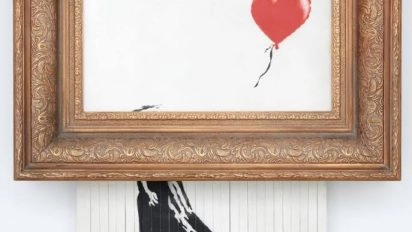
Love Is in the Bin was not the original artwork hanging on the wall before the bidding ended. What stood there was a version of Banksy’s Girl with Balloon, one of Banksy’s most famous artworks: a child reaching toward a red heart-shaped balloon, a picture often read as hope, innocence, longing, or loss. The title Love Is in the Bin arrived only after the sale, when the work passed through a hidden shredding mechanism concealed inside its frame and emerged altered. That distinction matters. The meaning does not begin with a damaged object alone; it begins with the instant an old image became a different work.
The event mattered because the destruction was not separate from the concept. It was the concept. A familiar Banksy image, already loaded with emotion, entered one of the most formal spaces in the art world: the auction room. There, after the hammer fell, the work interrupted its own conversion into a luxury commodity. The frame, normally something that protects and presents art, suddenly revealed itself as a machine. In one gesture, Banksy turned the sale itself into part of the artwork. The auction room was no longer just the setting. It became the stage.
That is why people still return to the piece as more than a stunt. If the work had simply been vandalised by accident, its story would be about loss. Instead, the damage was purposeful, timed, and public. The gasps in the room, the phones lifting into the air, the shock of watching the object change in real time: all of that became part of the artwork’s identity. Love Is in the Bin sits halfway between object and performance. It is something you can still look at, but it is also an event that cannot be separated from the memory of how it came into being.
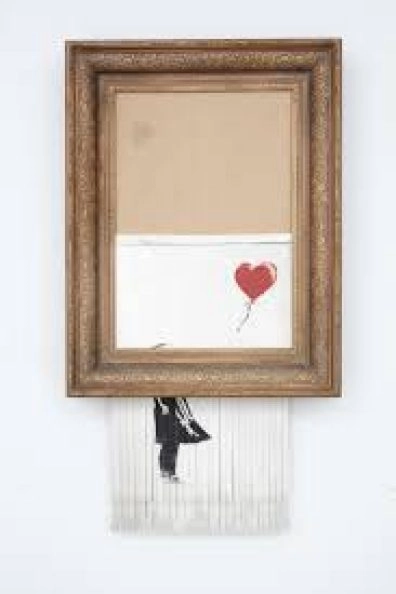
The partial shredding is crucial to the meaning. The work did not vanish. It remained suspended between survival and destruction, with part of the image intact and strips hanging below the frame. That in-between state makes the piece far richer than a simple act of annihilation. Had the image disappeared entirely, the meaning might have settled into a straightforward statement about refusal or sabotage. Because it remained visible, the work became a collision of two states at once: before and after, complete and ruined, sold and still under the artist’s influence.
Seen this way, Love Is in the Bin is about transformation under pressure. Girl with Balloon had long been circulated as an accessible, almost tender image. After the auction, that softness became unstable. The heart-shaped balloon still suggests feeling, but now it exists alongside machinery, money, and public drama. Viewers are no longer invited to read the image only as romantic or wistful. They have to read it through the violence of the event that changed it.
The work also exposes something basic about contemporary art: meaning does not live in the object alone. It lives in context, timing, intention, and reception. The same visual image, once put through that live intervention, became newly charged. A framed artwork became a performance. A sale became a critique. Damage became authorship. In that sense, Love Is in the Bin was born not despite the auction, but through it.
This is the key to understanding the piece from the start. Its meaning is not hidden behind technical art language or private symbolism. It is visible in the transformation itself. Destruction, spectacle, and creation all happen at once, and that impossible overlap is exactly what gives the work its lasting power.

The key moments behind the shred
| Moment | What happened | Why it matters |
|---|---|---|
| Before the auction | A framed version of Banksy’s Girl with Balloon entered the market as a known Banksy work, connected to one of his most famous motifs. Long before the auction room drama, the image already carried emotional weight because of its simple composition and open symbolism. | This is the starting point: Love Is in the Bin did not begin as an entirely separate image. It began as a familiar Banksy work that viewers thought they understood, which made the later transformation far more powerful. |
| The 2018 Sotheby’s sale | When the lot was offered at Sotheby’s in 2018, it moved through the normal ritual of the art market: bidding, suspense, a final hammer price, and the public confirmation that the work had been sold. | The sale matters because Banksy did not interrupt the work before it entered the market. He let the market complete its ceremony first. That timing turned the sale itself into part of the artwork’s meaning. |
| The hidden mechanism activates | Immediately after the hammer fell, a shredding device hidden inside the frame activated. In practical terms, this is what Banksy did to the work: he had arranged for the framed artwork to pass into blades built into the frame, so the intervention happened from inside the object itself. | This answers a common question directly. Banksy did not later damage a work already called Love Is in the Bin. He engineered the earlier Girl with Balloon to shred at the moment of sale, and that act produced the work now known as Love Is in the Bin. |
| Partial destruction, not total disappearance | The work did not shred all the way through. Instead, part of the image remained in the frame while the lower section hung below in strips. Because the piece stopped in this altered state, the audience saw a transformed object rather than a complete absence. | This explains why Banksy’s Girl with Balloon shredded without simply disappearing. The mechanism activated, but the result was partial. That partial outcome is exactly what allowed the work to survive as a new visual composition and not just as a story about destruction. |
| Immediate aftermath | The room reacted with shock, and the event spread instantly through global media. What could have been a brief auction incident became an international cultural moment within hours because images and videos circulated far beyond the sale room. | The work’s history is inseparable from that public reaction. Spectacle was not a side effect. It helped define the piece. The audience, the cameras, and the speed of attention all became part of the artwork’s cultural life. |
| Retitling and recognition | After the event, the transformed piece was retitled Love Is in the Bin and recognised as a distinct work rather than being treated only as a damaged version of the earlier one. Banksy’s authentication body, Pest Control, formally authenticated the new state of the artwork. | This institutional step is vital. It gave the transformed object official standing in the art world. Without that recognition, the piece might have remained a famous accident. With it, the shred became part of the work’s accepted identity and provenance. |
| Later resale | The work later returned to auction and sold again as Love Is in the Bin, not as Girl with Balloon. By then, its identity as a separate artwork had fully taken hold in both cultural and market terms. | The resale showed that the transformed work was not a temporary curiosity. It had entered art history as a landmark contemporary piece, and its market treatment confirmed that the shred had become central to its meaning, not a footnote to it. |
What the title says about love, value, and authorship
If you are looking for the shortest possible Love Is in the Bin meaning, it is this: the new title turns a hopeful image into a question about what survives once feeling is packaged, sold, and put on display. Girl with Balloon sounds open, tender, and poetic. Love Is in the Bin sounds blunt, ironic, and unstable. The emotional weather changes immediately.
That shift matters because the original image had often been treated as one of Banksy’s softer works. A child reaching for a heart-shaped balloon invites sentimental readings almost automatically. People see innocence, romance, loss, memory, or hope slipping away. The new title interrupts that comfort. A bin is where unwanted things go. It suggests disposal, waste, and the end of value. Suddenly the image is no longer just about love drifting out of reach. It becomes about what happens when love itself is handled as something that can be consumed, traded, and discarded.
At the same time, the work is not simply anti-love. That would flatten it too much. The image still contains feeling, and the surviving upper portion still holds onto the delicacy that made Girl with Balloon resonate so widely. What changes is the setting around that feeling. Love is no longer untouched. It is caught inside systems of money, ownership, and spectacle. That is a more precise way to understand Banksy’s Love Is in the Bin meaning: it is less a rejection of emotion than a challenge to emotion once it is turned into a commodity.
The title also sharpens the piece’s criticism of the art market. Once a tender symbol enters the machinery of an auction room, it becomes a lot number, a financial asset, and a social event. The new name seems to ask whether something intimate can remain innocent after that. When the work self-destructs at the point of sale, it stages a clash between symbolic value and market value. Is the heart balloon still a symbol of feeling, or has it become a luxury object whose power depends on price, rarity, and headlines? The title refuses to let those two readings sit comfortably together.
Authorship is another major part of the puzzle. In most sales, the hammer suggests closure: the object is finished, ownership is settled, and the work moves from seller to buyer. Banksy disrupted that logic. By intervening after the sale, he blurred the line between the completed artwork and the ongoing artistic act. In effect, he showed that authorship had not fully ended at the point where the market believed it had taken control. The artist re-entered the scene at the most symbolic possible moment.
That is why the title does more than rename a damaged piece. It reframes the whole event. Love Is in the Bin suggests that what has been thrown away may not be the artwork itself, but the comforting illusion that art can be cleanly separated from commerce. The title makes the emotional image harder to consume as pure romance, and it makes the auction harder to see as a neutral marketplace. Each contaminates the other.
So when people search for love is in the bin meaning, or ask about the Banksy Love Is in the Bin meaning specifically, the answer lies in this tension. The work holds intimacy and commodification in the same frame. It preserves the emotional pull of the image while exposing what happens when that emotion is bought, displayed, and transformed into public spectacle. The result is not a simple moral lesson. It is a contradiction made visible, and that contradiction is the point.
Why the work became more valuable after the shred
The strangest part of the story is also one of the most revealing: the shredding did not erase the work’s value. It increased it. On the surface, that looks like a contradiction. A gesture that seemed to mock the art market was instantly absorbed by the market and rewarded by it. But that paradox is exactly why Love Is in the Bin became so significant. The market did not treat the shred as damage alone. It treated it as the birth of something rarer, more historically important, and more culturally charged.
One reason is uniqueness. There are many images associated with Banksy, and there are many works that become famous through reproduction. Love Is in the Bin is different because it is inseparable from a singular event. It is not just a Banksy object; it is the documented result of one of the most widely discussed auction interventions in contemporary art. Its physical state cannot be copied by simply reproducing the image. The work’s exact form depends on that one public moment.
Another reason is provenance. In art, provenance is not a small administrative detail. It is part of what gives a work legitimacy, continuity, and narrative force. Love Is in the Bin has unusually strong provenance because its transformation happened in full public view, at a major auction house, and was later authenticated under its new title. Its history is unusually clear, unusually dramatic, and unusually memorable. Collectors were not looking at a damaged work with an uncertain story. They were looking at authentic Banksy art whose story had already entered contemporary art history.
Global attention also mattered. The shredding was not only seen by people in the room; it was replayed across the world almost immediately. That visibility gave the work a scale of recognition that even major artworks rarely achieve. It became a cultural landmark as much as a market object. In contemporary art, that kind of public memory can intensify demand because buyers are acquiring not just an image, but a moment everyone remembers.
The latest confirmed public benchmark shows how dramatic that shift was. The work sold in 2018 for just over £1 million, and the latest documented public sale remains its 2021 Sotheby’s resale at £18,582,000. As of 2026, that 2021 result is still the last confirmed public price. So if someone asks, “How much is Love Is in the Bin worth now?”, the careful answer is that its latest proven public value is £18.582 million, while any newer figure would be speculative unless another sale becomes public.
That distinction matters. People often want a current number, but art values are not updated like stock prices. Without a later public transaction, an exact present-day value cannot be confirmed. Observers may assume the work would command a very high figure if it returned to market, especially because of Banksy’s global profile and the piece’s art-historical status, but that remains an estimate, not a documented fact.
The deeper point is that the price rise is not separate from the meaning. It completes the irony. A work that appeared to attack commodification became even more desirable because of that attack. The market did not neutralise the artwork’s message so much as prove it. Love Is in the Bin shows how rebellion, once spectacular enough, can be turned into value. That reaction is not a side note to the artwork. It is part of the artwork’s story, and part of what makes it so sharp.
How this piece fits Banksy’s wider art
To understand why Love Is in the Bin feels so recognisably Banksy, it helps to place it inside the larger pattern of his work. The deeper meaning behind Banksy’s art often comes from a simple image colliding with a disruptive idea, and this piece follows that pattern closely.
- Banksy often starts with images that feel instantly readable. A child, a balloon, a rat, a policeman, a flower: the visual language is direct enough that almost anyone can enter the work without specialist knowledge. That accessibility is central to his power. Love Is in the Bin begins with one of his clearest, most emotionally legible images, then complicates it through context and action.
- He repeatedly questions authority, and not only political authority. Cultural authority matters too. Auction houses, collectors, museums, and art-world gatekeepers all shape what counts as important. By placing his intervention inside an auction setting, Banksy did not stand outside the system throwing stones at it. He stepped inside it and exposed its rituals from within.
- Spectacle is part of the medium in Banksy’s practice. His works often travel through photographs, headlines, public surprise, and shared reactions. That does not make them empty. It means the public life of the artwork is part of the artwork. Love Is in the Bin fits perfectly here: the gasp in the room and the worldwide replay were not distractions from meaning; they helped produce it.
- Banksy’s art is accessible, but it rarely offers easy comfort. That tension is one of the deeper meanings behind his work overall. The image may be simple, even playful, while the message cuts into power, hypocrisy, violence, or commodification. In Love Is in the Bin, the soft emotional pull of the balloon clashes with the aggressive mechanics of the shred and the hard reality of the sale.
- Anti-establishment thinking runs through much of Banksy’s work, but it is rarely expressed as a flat slogan. He often shows how systems absorb resistance and sell it back to the public. This piece is a perfect example. The work appears to resist the market, yet the market turns that resistance into even greater prestige and value. The contradiction is not a failure of the work. It is part of its insight.
- Banksy also likes to blur the boundary between finished object and ongoing act. Murals can be removed, erased, protected, sold, or recontextualised. Meaning keeps shifting as institutions and audiences respond. Love Is in the Bin pushes that habit to an extreme by showing that the artwork was not fully finished when everyone thought it was. The artist reasserted control at the very moment control seemed to pass to the buyer.
- Finally, the piece reflects Banksy’s long interest in public readability and cultural friction. You do not need an art history degree to understand that something unsettling happened when a sold work shredded itself. Yet the implications keep opening outward: authorship, ownership, spectacle, and value all come into play. That mix of clarity and friction is a hallmark of Banksy’s wider practice.
- If you want to explore those themes in a broader contemporary art context, Moco Museum’s Banksy museum Amsterdam page, alongside related artist and exhibition pages, especially in London and Barcelona, can offer a useful way to connect this work to bigger conversations around street art, institutions, and accessible contemporary art. Seen in that wider frame, Love Is in the Bin does not look like an isolated prank. It looks like a concentrated version of the questions Banksy has been asking all along.