This guide keeps expectations realistic. It covers Banksy’s Bristol roots, the key works to know, and how to plan a self-guided walk around what you can actually see.
Why Bristol helped shape Banksy’s early voice
Bristol is where Banksy’s public language feels most grounded. Rather than coming up through a traditional art-world route, his early voice took shape in the city’s 1990s underground scene: stencil work, dark humour, and images that could hit politics, policing, class, and everyday absurdity in a single glance. That suited Bristol’s creative and political energy. Robin Gunningham’s Easton connection has been widely reported, but Banksy’s identity remains officially unconfirmed. Even after global fame, Bristol still feels like the clearest starting point for understanding Banksy.
The Banksy works worth looking for in Bristol
Yes, there is still Banksy art linked to Bristol – but the easiest pieces to combine are not the whole story. The first four stops below work best from the centre; the rest need extra travel or are better treated as historic or indoor connections.
| Work | Area/location | How to recognise it | Viewing status |
|---|---|---|---|
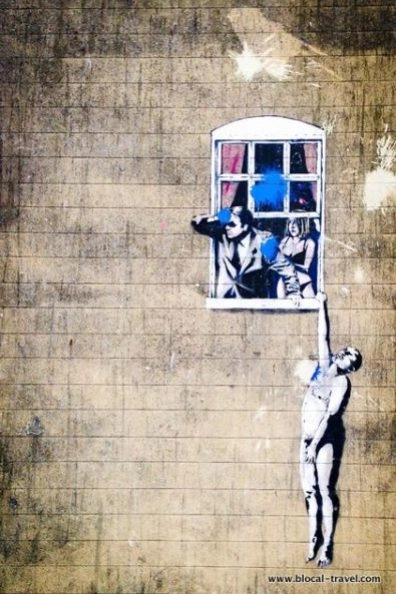
| Well Hung Lover | Frogmore Street | Naked man hanging below a window | Street-visible in the central cluster |
| Girl with a Pierced Eardrum | Harbourside / Hanover Place | Vermeer parody using a wall alarm as the “pearl” | Street-visible; condition and obstructions can change |
| The Grim Reaper | Harbourside / Thekla | Hooded skeleton on Thekla’s hull | Often visible from outside; condition can vary |
| The Mild Mild West | Stokes Croft | Teddy bear throwing a Molotov at riot police | Street-visible landmark; periodically protected |
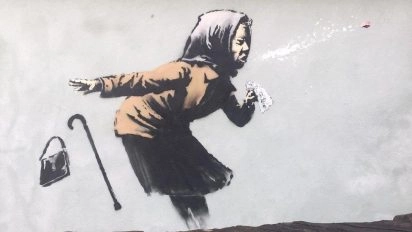
| Aachoo!! | Totterdown | Sneezing woman blasting out dentures | Original street view is no longer a simple public stop |
| Rose on a Mouse Trap | Easton-linked | Early rose-and-trap image | Historically important, but not a dependable wall view |
| You Don’t Need Planning Permission to Build Castles in the Sky | Barton Hill | Text-based slogan work | Known in Bristol history, not a reliable current sighting |
| Paint Pot Angel | Museum-linked Bristol piece | Classical angel topped with a paint pot | Indoor/collection context, not an outdoor mural stop |
Visibility and access can change quickly, so treat this as a current overview rather than a permanent guarantee.
How to plan a Banksy walk that actually works
- Start with the central cluster. Well Hung Lover, Girl with a Pierced Eardrum, and The Grim Reaper are the most practical first stops.
- Add Stokes Croft next if The Mild Mild West is non-negotiable. It is worth it, but it turns a short centre walk into a longer outing.
- Treat Totterdown and Easton/Barton Hill as separate add-ons, not casual extras. They are spread out, and some associated works are relocated or no longer reliably viewable.
- Check recent access before you leave. A map pin does not tell you whether a work is indoors, screened, obstructed, or gone.
- Leave space to go beyond Banksy. Stokes Croft especially can expand into a broader Bristol graffiti tour.
What these Bristol murals reveal about Banksy’s ideas
What makes the Bristol murals so revealing is how quickly they communicate. The Mild Mild West, with its teddy bear facing riot police, turns a local wall into a sharp image of social tension, absurd resistance, and anti-authority feeling; that is why many people treat it as the defining Bristol Banksy. Girl with a Pierced Eardrum borrows a familiar pose and lets the building’s alarm box become the joke. Well Hung Lover uses melodrama and a perfectly chosen site to make its humour land instantly. On Bristol’s walls, Banksy made the art-versus-graffiti debate hard to separate: street interventions with the clarity and staying power of public art.
Street murals are only part of the story: protected works, museum pieces, and prints
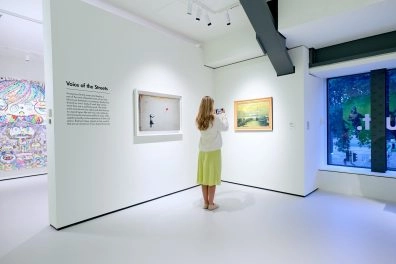
Bristol is not a perfectly preserved open-air Banksy museum. Public works face weather, cleaning, redevelopment, ownership disputes, and protection, so the city’s Banksy map keeps changing. That is the key difference between an original mural in situ and meeting Banksy through posters, prints, editions, or museum displays. Aachoo!! shows how quickly a wall piece can move beyond simple street viewing, while Paint Pot Angel belongs more to an indoor encounter. The Grim Reaper and Barton Hill-linked works also show that condition and access are never fixed. For an indoor perspective beyond the street, a modern art museum can present Banksy in a curated context.