Drawing Underground: Keith Haring’s Subway Drawings
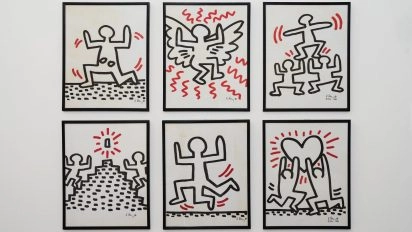
Between 1980 and 1985, Haring began using unused advertising panels in New York City subway stations as surfaces for chalk drawings. The subway offered something that the studio could not: a constantly changing public and an environment in which images had to communicate immediately. Haring worked fast, sometimes producing dozens of drawings during a single session, while commuters passed around him. Drawing became both an artistic process and a public act.
That environment helped shape the directness of Haring’s drawing. Chalk encouraged speed and confidence, leaving little room for correction, while the proportions of the advertising panels provided a ready-made frame. A few lines could suggest a body in motion; marks surrounding a figure could create energy; an image repeated often enough could begin to function as a symbol.
This was not simply a matter of developing a recognisable style. Haring was building a visual vocabulary that could be understood quickly, without requiring specialist knowledge.
A Visual Language That Could Travel
Certain images became recurring characters in Haring’s work: the Radiant Baby, the Barking Dog, dancing bodies, human pyramids and UFOs. Yet these symbols were not a fixed alphabet in which every image had one permanent definition. Haring altered and recombined them, allowing their associations to shift according to their surroundings. Within the interpretation of Simply Haring, the Radiant Baby is connected to hope and optimism, while the Barking Dog can evoke authority, protest and resistance; UFO imagery introduces ideas of mystery and otherness.
The adaptability of this language became significant as Haring’s work moved beyond the subway. His imagery appeared in galleries and publications, but also in music, nightlife, posters, social campaigns and everyday objects. Haring was working in an early-1980s New York in which graffiti, hip-hop, club culture, performance and visual art occupied the same spaces. Music and dance found their way into his work through figures that twist, jump and balance.
This ability to cross boundaries became a defining element of Keith Haring and his wider artistic practice.
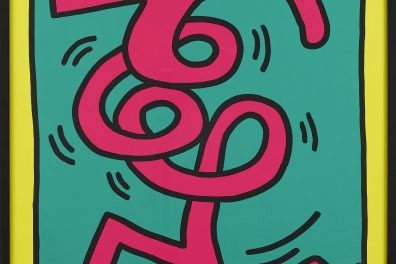
The collection brought together in Simply Haring makes this movement particularly visible. Posters created in connection with the Montreux Jazz Festival sit within the same exhibition as Pop Shop material, publications, gallery collaborations and works associated with social campaigns. The formats change, yet Haring’s visual identity remains intact.
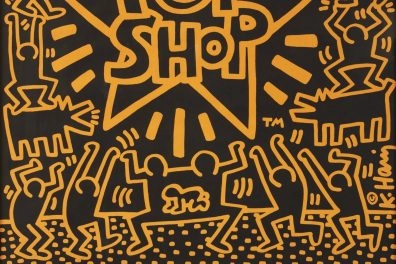
The Pop Shop perhaps made this idea most explicit. Haring’s imagery could appear on objects that people could buy, carry and encounter as part of everyday life. Rather than treating the movement between art and popular culture as a contradiction, it became another way of extending the reach of his work. A drawing, poster, publication or shopping bag could all become carriers of the same visual language.
“If I only made art for galleries, I would probably be frustrated all the time.”
When Art Has No Barriers
The immediacy of Haring’s work could make it playful, but it also made it powerful. The same visual clarity that allowed an image to register with a passing commuter could be used to draw attention to subjects that were urgent, difficult and political.
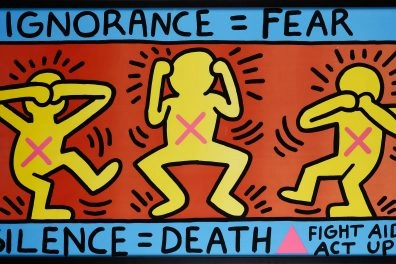
Haring lived and worked during a period marked by inequality, the Cold War, the threat of nuclear disaster and the AIDS crisis. Rather than abandoning his familiar imagery when addressing these subjects, he used it to communicate them more directly. Free South Africa, Nuclear Disarmament, Crack Down! and Ignorance = Fear / Silence = Death address apartheid, nuclear weapons, drug abuse and AIDS awareness through a vocabulary that remains his own.
Haring figures may dance, radiate and move with extraordinary energy, while the subject underneath can be fear, inequality, illness or political injustice. Accessibility did not require simplicity of meaning; it allowed ideas to enter public space.
Keith Haring’s Art: A Language in Motion
Seen together in Simply Haring, these different strands of Haring’s practice begin to feel less like separate chapters than parts of the same idea. The Subway Drawings, posters, publications, objects, collaborations and socially engaged works all demonstrate an interest in how images communicate and what happens when art moves beyond the places traditionally reserved for it.
The subway is therefore an important beginning, but not the end of the story. It provided Haring with an environment in which speed, repetition and public encounter could shape a new way of drawing. What followed was the expansion of that language into almost every part of contemporary visual culture around him.
Perhaps this is why Haring’s imagery remains so immediately recognisable. Its strength does not depend on a particular material, scale or setting. The same line can exist in chalk on a subway panel, across a poster, inside a publication or on an everyday object and still carry Haring’s style.
Simply Haring traces that journey: not simply from subway to gallery, but from a line to a language, and from a language into the world.
See Keith Haring Art in London at Simply Haring
Simply Haring is on view at Moco Museum London from 2 October 2026 until 2 January 2027.
Simply Haring presents attributed Subway Drawings alongside prints, posters, publications, objects and collaborations, showing how Keith Haring’s visual language moved between public space, art, popular culture and activism.
Moco Museum is an independent modern and contemporary art museum with locations in Amsterdam, Barcelona and London, presenting modern, contemporary, digital, immersive and street art through accessible and emotionally engaging experiences.
Explore exhibitions at Moco Museum London

Practical Information
-
Opening Hours
Monday – Thursday: 10:00 – 19:00
Friday – Saturday: 10:00 – 20:00
Sunday: 10:00 – 19:00
-
Duration
Approximately 90-120 minutes
-
Location
1-4 Marble Arch, London, UK.
Get directions via this link. Check out things to do in the area!
-
Contact
Email us at [email protected] or visit our contact page.
-
Audio tour
Free audio tour, bring your headphones.
-
About
Moco Museum London is an independent modern and contemporary art museum presenting influential contemporary voices including Banksy, Warhol, Basquiat, Haring, Kusama, and Robbie Williams, focused on modern, contemporary, digital and immersive art that reflects life today.
Frequently Asked Questions
About Keith Haring Art in London
Where can I see Keith Haring art in London?
Simply Haring is on view at Moco Museum London from 2 October 2026 to 2 January 2027 and presents attributed Subway Drawings alongside prints, posters, publications, objects and collaborations.
What is Simply Haring at Moco Museum London?
Simply Haring is a temporary Keith Haring exhibition exploring how his visual vocabulary developed and circulated from the New York subway into galleries, publications, popular culture, social campaigns and everyday objects.
What are Keith Haring’s Subway Drawings?
Between 1980 and 1985, Haring used unused advertising panels in New York City subway stations as surfaces for chalk drawings. Working in a public environment helped shape the speed, directness and visual vocabulary explored throughout Simply Haring.
Where can I get tickets for the Keith Haring exhibition in London?
Tickets and current visitor information for Simply Haring are available on the official Moco Museum London Visit & Tickets page.