Famous Banksy Artworks and Where They Are Today
Banksy’s images have travelled far beyond the walls where many first appeared. Their meanings have travelled too. From protest and surveillance to hope, authority, and contradiction, these works reveal why Banksy has become such an influential figure in contemporary visual culture.
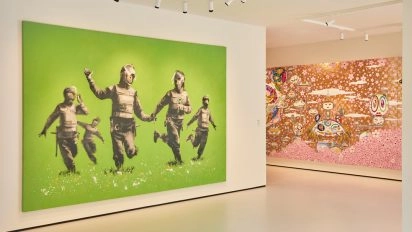
Moco has followed the movement of street art into museum and collection contexts closely. Moco Museum Amsterdam presents Banksy within a wider programme of modern, contemporary, digital, immersive, and street art. Banksy’s work has held an important place in that story, allowing authenticated works to be considered alongside the culture and questions from which his visual language emerged.
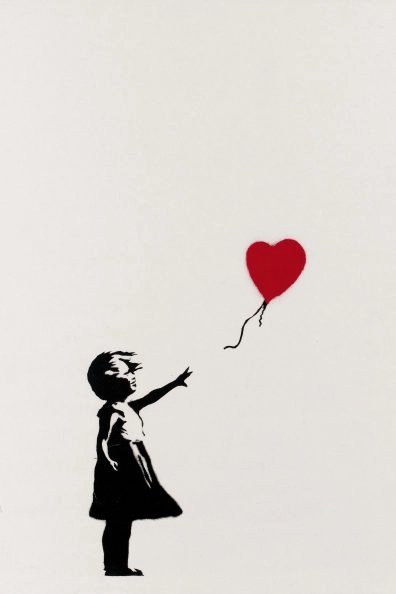
Girl with Balloon: Hope, Loss, and an Image That Kept Changing
Few Banksy artworks communicate so much with so little. Girl with Balloon depicts a young girl reaching towards, or perhaps releasing, a red heart shaped balloon. The ambiguity is part of its power. Is she losing something, or letting it go?
The image appeared in London in 2002, including a version on the South Bank near Waterloo Bridge accompanied by the words “There is always hope.” The original street image no longer survives there. Yet Girl with Balloon continued through authenticated paintings, prints, and other iterations, turning a temporary intervention into one of Banksy’s most recognisable motifs.
Its cultural reach grew because the image remained emotionally open. Hope and loss can exist in the same gesture. In 2018, another version entered art history when a framed Girl with Balloon partially shredded itself immediately after selling at auction. Banksy subsequently renamed the transformed artwork Love Is in the Bin. The event added another layer to the artist’s continuing tension with ownership, value, and the institutional art market.
Girl with Balloon appeared as street art in London in 2002, including a version near Waterloo Bridge. That street work no longer survives there, but the image also exists in authenticated paintings, prints, and other physical forms.
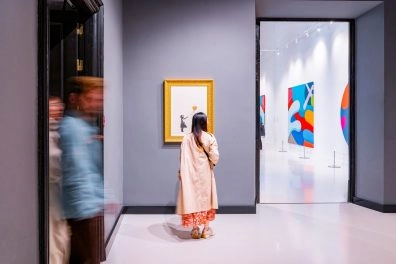
Girl with Balloon is also associated with the Banksy presentation at Moco Museum Amsterdam. Because Moco’s collection and loaned works can rotate, visitors should not assume that every artwork referenced online will be on view during every visit.
Love is in the Air: Flowers Instead of Violence
The body tells you to expect violence. A masked figure leans backwards, arm raised, ready to throw. Then you notice what is in his hand: a bouquet of flowers.
Love is in the Air, widely known as Flower Thrower, first appeared on the side of a garage in Beit Sahour, near Bethlehem in the West Bank, in 2003. The image emerged in a landscape marked by conflict and division. Instead of removing the visual language of confrontation, Banksy interrupts it.
Flowers occupy the place where the eye anticipates a stone or weapon. Anger remains visible in the figure’s movement, yet what he throws suggests peace. That simple substitution helped the image move beyond its original setting to become one of Banksy’s most widely recognised statements about violence and resistance.
The image later appeared in authenticated prints and other physical forms. This is why asking for the location of a famous Banksy piece can have more than one answer. A street mural has a particular site and history, while an authenticated edition carrying the same image can belong to a collection somewhere else.
Flower Thrower is among the Banksy imagery represented in Moco Museum Amsterdam’s Banksy presentation.
Laugh Now: When the Monkey Becomes a Mirror
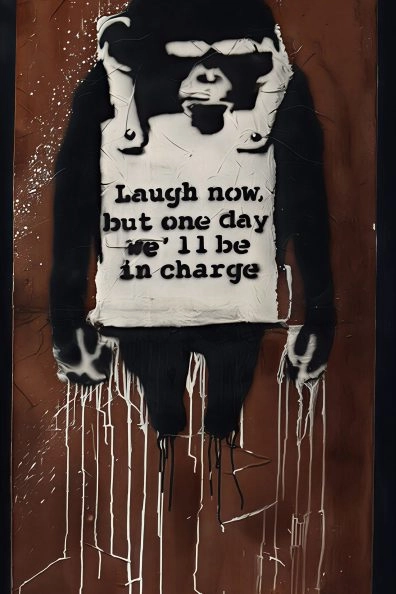
A chimpanzee stands with lowered shoulders, carrying a sandwich board with a warning about who will eventually be in charge. The joke arrives quickly. The discomfort takes a little longer.
Laugh Now emerged during the early period in which Banksy’s monkey imagery became central to his visual language. The motif developed across different physical works and editions, turning the monkey into one of Banksy’s most recognisable symbols.
Monkeys repeatedly appear in Banksy’s work as reflections of human contradiction, ambition, obedience, and authority. They make hierarchy look strange by turning it back on us. There is humour in the image, but the joke does not leave humanity untouched.
There is another reason Laugh Now matters. Banksy’s own cultural journey mirrors one of the tensions within the image. Street art once dismissed as vandalism now appears in private collections, auction houses, galleries, and museums. The question of who decides what counts as art becomes part of the work itself.
At Moco, Laugh Now gives its name to the Banksy exhibition in Amsterdam. The exhibition is not authorised by Banksy and was not curated by the artist. Moco states that the exhibited works have been provided with certificates of authenticity from Pest Control, the official entity that verifies Banksy’s work.
When Famous Banksy Street Art Leaves the Street
Some of Banksy’s best known works raise another question. What happens when an artwork created for a particular public wall becomes valuable enough to remove from it?
Kissing Coppers: Authority Meets Intimacy
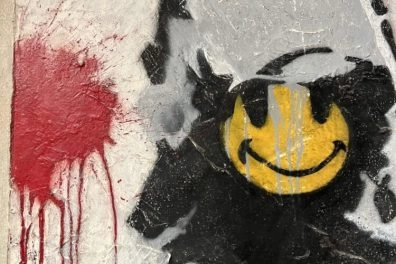
Kissing Coppers appeared on the side of the Prince Albert pub in Brighton in 2004. Two uniformed male police officers kiss, transforming figures associated with authority into an intimate image that challenged assumptions around masculinity, sexuality, and institutional power.
Its location was part of its force. This was not an image separated from everyday life by a gallery wall. It confronted people in public space, using figures of authority to create an unexpectedly vulnerable encounter.
After repeated damage, the original was removed from the pub and a replica was installed in its place. The removed work was later sold at auction in Miami in 2014.
Kissing Coppers first appeared on the Prince Albert pub in Brighton in 2004. The original was later removed, so the image currently associated with its original Brighton site is not the original mural.
Its journey raises a question at the centre of Banksy’s cultural significance. When street art leaves its street, does the artwork remain the same, or does the change of context become part of its story?
Well Hung Lover: A Banksy Still Connected to Bristol
Not every famous Banksy mural has disappeared from its original setting.
Created in Bristol in 2006, Well Hung Lover shows a naked man hanging from a window while another man looks outside, apparently searching for him. The story unfolds in a single suspended moment. Architecture is not simply the surface for the work. The building itself becomes part of the joke.
Well Hung Lover was painted in Bristol in 2006 and remains at its original location overlooking the area around Park Street and Frogmore Street. The mural has been altered and damaged over time, so its present condition differs from its original appearance.
Its survival matters because street art is vulnerable by nature. Walls change ownership. Buildings change. Paint fades. Other people leave their own marks. A surviving Banksy mural therefore carries not only the artist’s intervention, but also the history of everything that has happened around it.
One Nation Under CCTV: A Work About Being Watched
Few Banksy works depended on their surroundings as sharply as One Nation Under CCTV.
The large London mural showed a hooded figure painting the words “ONE NATION UNDER CCTV” while a police officer and dog watched nearby. Its imagery turned surveillance into both subject and setting.
The work appeared on Newman Street in central London and was documented there in 2008. Westminster City Council subsequently ordered its removal, arguing that the same rules should apply to Banksy as to other graffiti artists. The mural was later painted over.
The disappearance almost completes the work. An image questioning authority was itself subjected to authority. What survives is no longer the original wall painting, but its photographs, documentation, memory, and cultural afterlife.
One Nation Under CCTV appeared on Newman Street in central London and was documented there in 2008. Westminster City Council ordered its removal, and the original mural no longer survives at the site.
Why Famous Banksy Images Can Exist in More Than One Form
A famous Banksy image is not necessarily a single physical artwork. Banksy motifs can exist as street murals, paintings, screenprints, editions, and other authenticated works. The original street version may therefore have a different location and status from an authenticated version held in a collection.
This distinction is essential when talking about Banksy. Girl with Balloon can refer to a lost London street image, an authenticated print, a painting, or another iteration of the motif. Love is in the Air similarly exists beyond its original wall. Familiar Banksy imagery can travel while individual physical artworks remain distinct.
Authentication adds another layer. Pest Control verifies Banksy artworks, while street works present a different authentication issue. A familiar image alone does not make an object an authenticated Banksy artwork.
At Moco Museum Amsterdam, the Banksy museum experience in Amsterdam brings authenticated Banksy works into a museum context. The Laugh Now exhibition is unauthorised and was not curated in collaboration with Banksy. This distinction matters because presenting authenticated works is not the same as claiming endorsement or collaboration with the artist.
For more context on the artist, explore Banksy and his work, or discover how his practice connects to the wider history and visual language of street art.
From the Street to the Museum
Banksy creates an unusual challenge for museums. His art is closely connected to questions of public space, authority, ownership, protest, and rebellion. At the same time, his practice also includes authenticated works created for circulation beyond the street.
Moco Museum is an independent modern and contemporary art museum with locations in Amsterdam, Barcelona, and London. It presents modern, contemporary, digital, immersive, and street art through accessible and emotionally engaging experiences. Banksy has held a significant place within Moco’s programme, reflecting the museum’s interest in artists who question established cultural boundaries.
The museum cannot recreate the street, nor should it pretend to. Instead, seeing Banksy art in Amsterdam offers another type of encounter. Authenticated works can be viewed closely and considered across recurring themes such as protest, power, surveillance, humour, and resistance.
That tension is part of why Banksy continues to matter. An image can move from a public wall into a collection, from local intervention into global visual culture, yet the questions inside it remain difficult to contain.
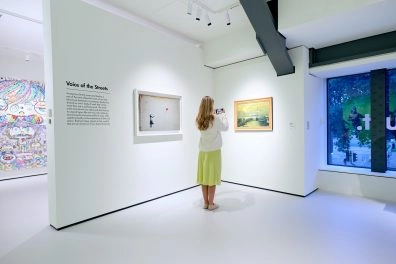
See Banksy Art at Moco Museum Amsterdam
Moco Museum Amsterdam is located at Honthorststraat 20, next to the Van Gogh Museum in Amsterdam’s Museumplein district. Its Banksy: Laugh Now exhibition presents authenticated Banksy works, although individual artworks can rotate and are not guaranteed to be on display during every visit.
Visitors can experience Banksy art in Amsterdam within a wider collection of modern, contemporary, digital, immersive, and street art. For current admission, opening hours, accessibility, and visitor details, plan your visit before arrival.
Look Beyond the Famous Image
Banksy’s most famous artworks survive in cultural memory because they do more than create instantly recognisable images. Flowers replace a weapon. A balloon holds hope and loss at once. Police officers kiss. A monkey turns human authority into a question.
Seeing authenticated Banksy works up close adds another chapter to that story. The street remains essential to understanding Banksy, but the museum offers a different kind of attention. It creates time to notice the details, contradictions, and connections that can disappear once an artwork becomes an icon.
Discover Banksy at Moco Museum Amsterdam and look again at the images you thought you already knew.
Frequently Asked Questions
What are Banksy’s most famous artworks?
Banksy’s most recognisable artworks and images include Girl with Balloon, Love is in the Air, also known as Flower Thrower, Laugh Now, Kissing Coppers, Well Hung Lover, and One Nation Under CCTV. His wider practice includes murals, paintings, prints, installations, and editions.
Where is the original Girl with Balloon?
Girl with Balloon appeared as street art in London in 2002, including a version near Waterloo Bridge on the South Bank. That street work no longer survives there. Authenticated versions of the image also exist as paintings and prints.
Where is Banksy’s Flower Thrower?
The Love is in the Air image, widely known as Flower Thrower, first appeared on the side of a garage in Beit Sahour, near Bethlehem in the West Bank, in 2003. The image also exists in other physical forms.
Are famous Banksy images always original street artworks?
No. A familiar Banksy image may exist in several physical forms, including street works, paintings, screenprints, and editions. An authenticated edition should also be distinguished from an unauthorised reproduction that simply uses the same imagery.
Can I see Banksy art in Amsterdam?
Yes. Moco Museum Amsterdam presents authenticated Banksy works in its Laugh Now exhibition. The exhibition is not authorised by Banksy and was not curated by the artist. Artworks can rotate, so individual works are not guaranteed to be on display during every visit.
How are Banksy artworks authenticated?
Pest Control is the official entity responsible for verifying Banksy artworks. Moco Museum states that works exhibited in its Banksy presentation have been provided with certificates of authenticity from Pest Control.