
Richard Hambleton and the Origins of Street Art
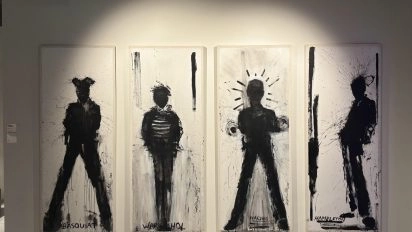
Born in Canada in 1952, Richard Hambleton was an artist regarded as one of the original figures of street art. Emerging in the 1970s and often referred to as the “Godfather of Street Art”, a title that he disliked, he played a key role in shaping the urban art movement, bridging the gap between Abstract Expressionism and the rise of street culture in major cities.
Hambleton gained international recognition in the 1980s, including participation in the Venice Biennale in 1984 and 1988.
He first attracted attention in 1976 with his series Image Mass Murder, in which he created chalk outlines of bodies on city pavements, often adding splashes of red paint resembling blood. These unsettling interventions looked like crime scenes, acting as a politically charged response to rising crime rates in the United States at the time.
Richard Hambleton and the Shadowman Series
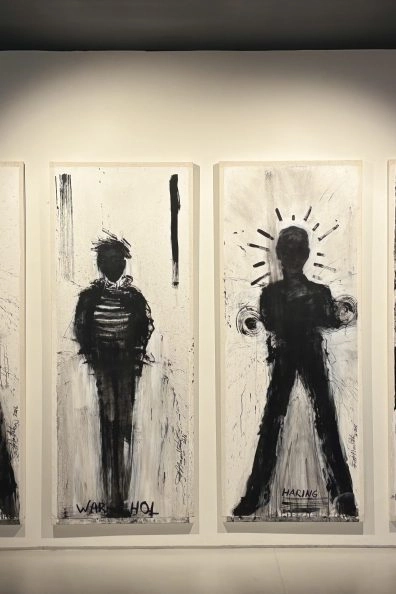
After moving to New York, Hambleton became a central figure in the downtown art scene. It was there that he developed his most iconic body of work, the Shadowman series.
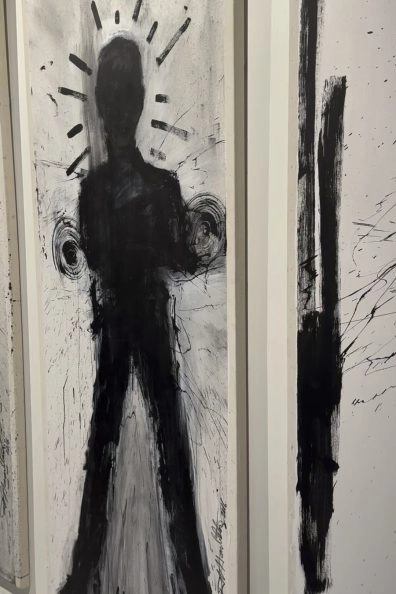
These life-sized, black silhouetted figures appeared suddenly on walls, alleyways and street corners, creating moments of surprise and unease. Mysterious and anonymous, the figures seemed to watch passersby, transforming the city into a stage for psychological encounter.
Hambleton described his approach simply: “I painted the town black”.
His interventions later extended beyond New York to cities such as Paris, London, Rome and Berlin, where he painted figures on both sides of the Berlin Wall.
Despite his early success, Hambleton’s career was affected by drug addiction, leading to a period of decline. In the final years of his life, however, his work was rediscovered, bringing a renewed appreciation of his contribution to contemporary art.
Icons, 2016
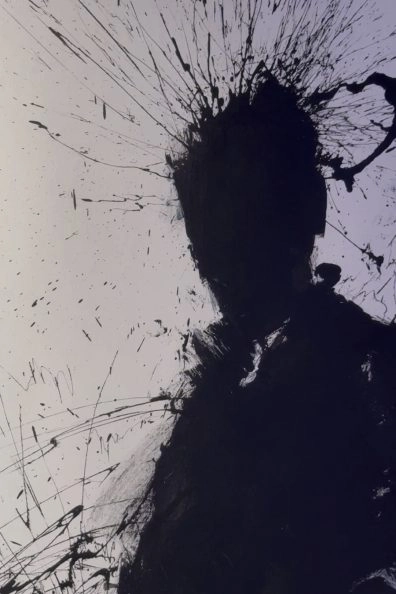
Icons, created in 2016, is a black and white acrylic on canvas measuring 30 x 80 cm.
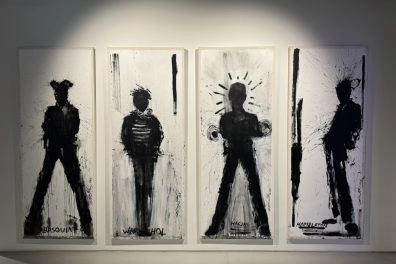
In Icons, Richard Hambleton presents a group of four figures that represent himself alongside three of his contemporaries: Jean-Michel Basquiat, Keith Haring and Andy Warhol.
The work reflects the close artistic and social connections that defined the New York art scene during the 1980s, where these artists shared ideas, spaces and a period of cultural transformation.
Jean-Michel Basquiat, Keith Haring and Andy Warhol in Icons
Rather than portraying Jean-Michel Basquiat, Keith Haring and Andy Warhol in a realistic way, Hambleton reduces each figure to a simplified, shadow-like silhouette.
Despite the artists’ different styles and approaches, they were all part of the same creative circle.
Through this piece, Hambleton pays tribute to Basquiat, Haring and Warhol while also positioning himself within this group, reinforcing the importance of collaboration and exchange in the development of the art world at that time.
The four figures bring together different artistic voices through Hambleton’s simplified, shadow-like approach. In doing so, Icons reflects the relationships between artists whose ideas and spaces intersected during a period of cultural transformation.

From the New York Art Scene to Icons
The connections at the centre of Icons are rooted in the New York art scene of the 1980s. Hambleton, Jean-Michel Basquiat, Keith Haring and Andy Warhol were part of the same creative circle, despite their different styles and approaches.
In Icons, those differences are reduced to four silhouettes. Hambleton presents the artists together, paying tribute to his contemporaries while placing himself alongside them.
The work reinforces the importance of collaboration and exchange in the development of the art world at that time. It also connects Hambleton’s shadow-like figures with the artistic relationships that shaped this period of his life and work.
Frequently Asked Questions
Who was Richard Hambleton?
Richard Hambleton was a Canadian artist born in 1952 who is regarded as one of the original figures of street art. Emerging in the 1970s, he played a key role in shaping the urban art movement.
What is Richard Hambleton known for?
Richard Hambleton first attracted attention in 1976 with his Image Mass Murder series. After moving to New York, he developed his most iconic body of work, the Shadowman series, featuring life-sized black silhouetted figures on walls, alleyways and street corners.
Who appears in Richard Hambleton’s Icons?
Richard Hambleton’s Icons presents Hambleton alongside Jean-Michel Basquiat, Keith Haring and Andy Warhol.
What does Richard Hambleton’s Icons represent?
Icons reflects the close artistic and social connections that defined the New York art scene during the 1980s. Through the work, Hambleton pays tribute to Basquiat, Haring and Warhol while positioning himself within the same creative circle.
How are Jean-Michel Basquiat, Keith Haring and Andy Warhol portrayed in Icons?
Hambleton does not portray the artists realistically. Instead, he reduces each figure to a simplified, shadow-like silhouette.
What materials did Richard Hambleton use for Icons?
Icons is a black and white acrylic on canvas created in 2016. The artwork measures 30 x 80 cm.
Reason to visit
Four artists, one creative circle. Icons brings Richard Hambleton together with Jean-Michel Basquiat, Keith Haring and Andy Warhol, reflecting the artistic and social connections that defined the New York art scene during the 1980s.
Discover the story behind Richard Hambleton’s Icons at Moco Museum London
Book tickets to experience Icons at Moco Museum London.