His celebrated works such as Balloon Dog, Popeye series, Gazing Ball series, challenge aesthetic hierarchies and invite viewers to explore the intersection of mass culture and. Now, at Moco Museum London showcasing some of his most iconic works from various series centred around inflatable flowers, live flowering plants and large-scale sculptures.
For anyone fascinated by the intersection of art, consumerism, and pop culture, the Jeff Koons exhibition in London, Moco Masters at the Moco Museum London is a must-see. Known for his provocative, borderline “kitsch”, playful works, Jeff Koons has a distinct body of work that has often garnered strong opinions by critics and art lovers alike. From his reflective balloon sculptures to his reinterpretations of classical figures, Koons’ art dances in the play space between high art and mass culture, ultimately inviting viewers to engage with familiar objects in entirely new ways.
Young Ambition
Born in 1955 in York, Pennsylvania, Jeff Koons showed a remarkable talent for drawing and painting from a young age. His father, an interior decorator, recognised his son’s gift and displayed Jeff’s artwork in his showroom.
This early experience of the art market shaped Koons’ understanding of art as both a creative and commercial endeavor, a foundational perspective that would guide his career.
Koons went on to study at the Maryland Institute College of Art in Baltimore and later transferred to the School of the Art Institute of Chicago. While studying art history, Koons became fascinated by the works of Marcel Duchamp and Andy Warhol, who questioned the nature of art by elevating everyday objects to the level of fine art. This influence inspired Koons to explore similar themes in his own work. One of his first solo exhibitiosn was held at Sonnabend Gallery, marking the beginning of a career that would challenge the traditional notion of what constitutes art.
In 1977, Koons moved to New York City to pursue his artistic career. To support himself, he worked as a commodities broker on Wall Street — an experience that deepened his understanding of consumer culture and its relationship to human desire. This theme would become central to his art, which explores the commodification of everyday objects and the way society assigns value to material things.
The Rise of Koons: breaking boundaries
Koons gained international recognition in the 1980s with his Banality series, which featured oversized sculptures of everyday objects and figures, including his famous Michael Jackson and pet chimpanzee sculpture. His celebration series featuring Balloon Dog, inflatable flowers and transparent colour coating techniques, solidified his status as a top-selling artist. Exhibitions at Gagosian Gallery, the Whitney Museum and the Guggenheim Museum Bilbao further established his influence in the world of contemporary art. His series “The New” and “Equilibrium”. Shockingly, they featured vacuum cleaners and basketballs in glass cases, preserved as if they were precious relics. By isolating these everyday objects and displaying them as art, Koons challenged the traditional boundaries between art and commercial products, echoing the voices of Duchamp and Warhol.
However, it was his “Celebration” series, which has garnered Koons the most attention. Launched in the early 1990s, Celebration remains one of Koons’ most ambitious and critically acclaimed projects. Inspired by childhood themes and personal milestones, the series explores the cyclical nature of life, using vibrant imagery of balloons, cake, and toys to evoke feelings of joy and nostalgia.
Koons began the series following the birth of his son, which reignited his fascination with the innocence and wonder of childhood. Through the use of stainless steel and mirror-finished surfaces, Koons transforms these childhood symbols into monumental objects of desire and luxury, inviting viewers to reconsider the commodification of innocence and the role of consumer culture in shaping identity.
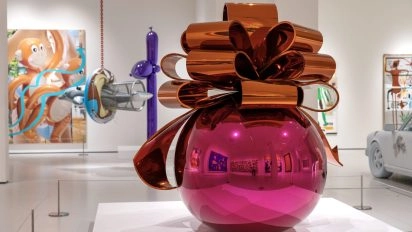
Smooth Egg with Bow
One of Koons’s works that continues to captivate audiences is Smooth Egg with Bow, an artwork that represents perfection and the commercial aesthetics of gift-giving. Using mirror-polished stainless steel, Koons creates a flawless illusion of a delicate yet monumental object. This piece is a prime example of how Koons makes everyday objects into profound reflections of consumerism and beauty.
Koons transforms this familiar object into a massive stainless-steel sculpture with a flawless mirror finish and a giant, luxurious bow. Representing fertility, life, and new beginnings, the egg is a symbol deeply-rooted in religious and cultural tradition. However, by magnifying the egg’s size and covering it in a hyper-glossy finish, Koons reflects modern society’s tendency to turn even the most sacred symbols into objects of consumer desire. The reflective surface invites viewers to see themselves within the artwork, reinforcing the idea that consumerism and identity are intrinsically linked.
The Popeye Series
A highlight of the Jeff Koons exhibition London is the Popeye series. In the Jeff Koons Popeye Series, Koons uses cartoon imagery and consumer objects to explore the intersection of high and low culture. The series exemplifies Koon’s ability to merge cultural history with visual culture, celebrating the familiar while challenging our perceptions of art.
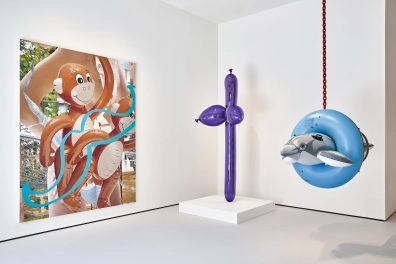
Dolphin Taz Trashcan (2007) is a surreal sculpture that dubiously presents an inflatable dolphin leaping through a trash can – however, all cleverly rendered in industrial materials.
The work reflects Koons’ exploration of mass media and consumer culture, highlighting the disposable nature of modern entertainment. Through the juxtaposition of playful imagery and industrial fabrication, Koons challenges viewers to reconsider the value we assign to both art and commercial objects.
Connecting Past and Present
Koons draws inspiration from classical art, as seen in his Antiquity series and Gazing Ball series, where he incorporates replicas of National gallery masterpieces with reflective gazing ball elements. His work continuously bridges the gap between the past and present, urging viewers to reconsider the influence of historical art movements on contemporary expressions.
Part of his “Antiquity” series, Balloon Venus Dolni Vestonice (2013-2015) is inspired by an ancient figure from 25,000 BCE. Koons enlarges the figure to monumental proportions and reimagines it as a reflective balloon sculpture. Believed to represent both male and female anatomy, this work explores themes of love, fertility, and human connection while reminding us that the human experience is both timeless and ever-changing.
Play: The Essence of Jeff Koon’s Art
At the heart of Koons’s work is a sense of play. Whether through the Hulk Elvis series, BMW art car or Equilibrium, the creations of Jeff Koons invite viewers to embrace curiosity, joy and wonder. His use of banal objects in a grand and refined manner challenges the traditional notion of high art, making his work both controversial and widely celebrated.
Beyond sculpture, Jeff Koons also produces paintings with his studio practice. Monkeys (Ladder) (2003) touches upon the similarities and the transition from childhood to adulthood through the playful imagery like the game “Barrel of Monkeys.” The painting presents a playful yet provocative examination of sexuality and emotional freedom, drawing parallels between childhood games and adult experiences.
Koons’ nod to Salvador Dalí through the whimsical moustache references surrealism’s influence on his work. The piece reflects Koons’ belief that pleasure and sensuality are integral to human identity.
Discover the Jeff Koons Exhibition at Moco Museum London
Step into the world of Jeff Koons at Moco Museum London and explore his most iconic works in an unparalleled exhibition. The Jeff Koons Moco experience offers visitors a chance to engage with Koons’s work. Whether you are a longtime admirer or new to his art, this contemporary art exhibition promises an immersive journey through the creative mind of one of the most influential artists of our time.
Exhibiting artists include



Reviews
Practical Information
-
Opening Hours
Monday – Thursday: 10:00 – 17:00
Friday – Saturday: 10:00 – 18:00
Sunday: 10:00 – 17:00
-
Duration
Approximately 90-120 minutes
-
Location
1-4 Marble Arch, London, UK.
Get directions via this link. Check out things to do in the area!
-
Contact
Email us at [email protected] or visit our contact page.
-
Audio tour
Free audio tour, bring your headphones.
-
About
Moco Museum London is an independent modern and contemporary art museum presenting influential contemporary voices including Banksy, Warhol, Basquiat, Haring, Kusama, and Robbie Williams, focused on modern, contemporary, digital and immersive art that reflects life today.
Reviews Media
-
 Head to the newly opened Moco Museum to find iconic works celebrated by modern artists and upcoming stars. Featuring works from “Moco Masters” Andy Warhol, Jean-Michel Basquiat and Keith Haring, the Moco Museum is home to a vast range of iconic and daring creations.
 -
 Head to the newly opened Moco Museum to find iconic works celebrated by modern artists and upcoming stars. Featuring works from “Moco Masters” Andy Warhol, Jean-Michel Basquiat and Keith Haring, the Moco Museum is home to a vast range of iconic and daring creations.
 -
 The scale of Moco Museum's London flagship is so impressive, it allows room for colossal, vital pieces by the likes of Daniel Arsham and Damien Hirst to sit alongside crowd-pleasers like Banksy's Flower Thrower. A must for any art lover and highly recommended.
 -
 Iconic works by internationally renowned artists and rising stars.
 -
 Experience the transformative power of performance art.
"The egg represents birth and new life, but the bow represents the commercialization of those experiences. Even innocence has been branded."